


FREE SITUATIONAL JUDGEMENT PRACTICE TESTS
1000s JT questions to help you pass your test at the first attempt.
Start Preparing Now 👉“I can honestly say this was the main reason how I PASSED my recruitment test.”
How2Become customer


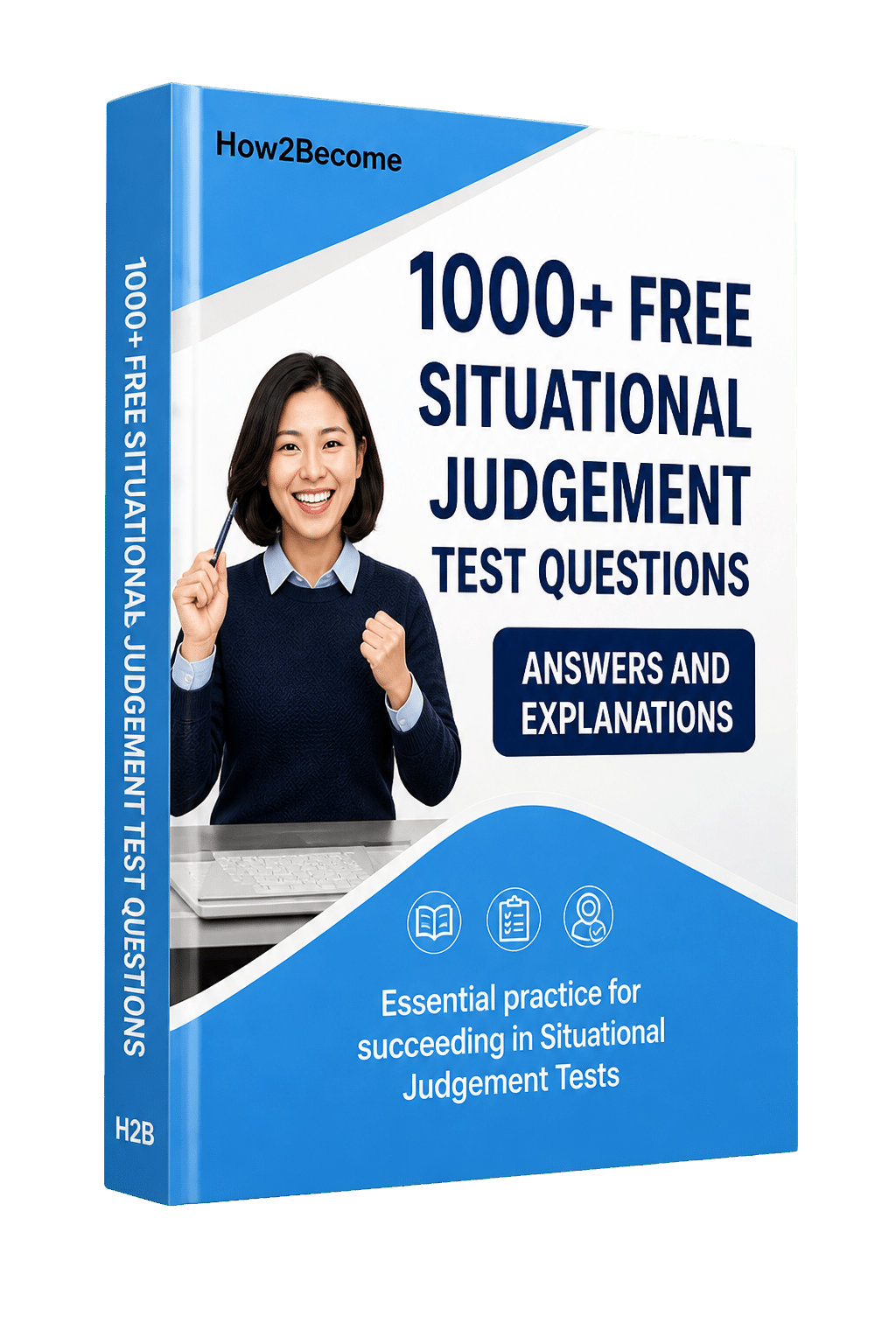
Practice Material That Works
Discover insider secrets and a masterclass of situational judgement practice tests material that has helped thousands of candidates pass their SJT.
Unlock Your Potential
Whether you’re just starting out or you know what to expect, you will get access to 1000s of questions, fully-worked solutions that will catapult your chances of success.
Powerful Resources
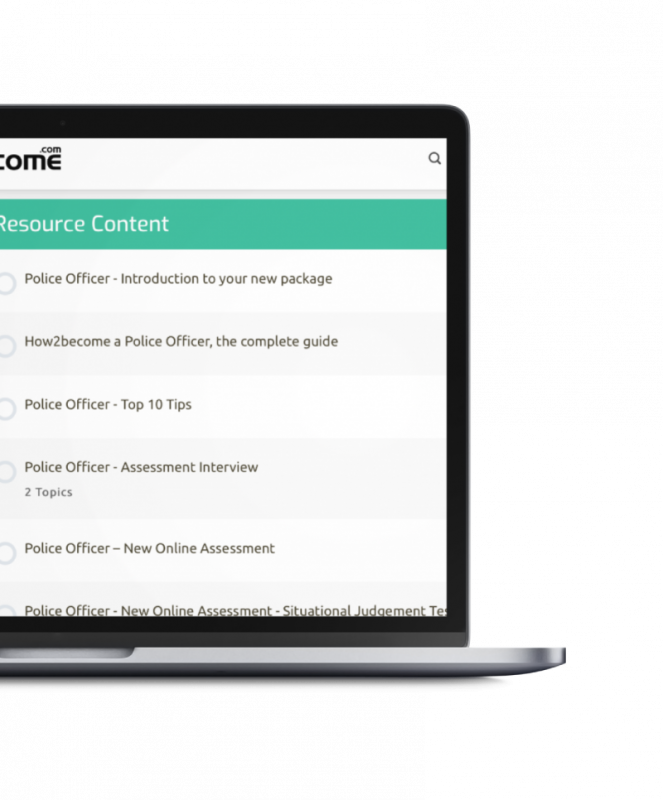
Get instant access to the material right now which includes all types of scenarios, andtraining on how to answer each question, and 1000s of practice questions.












FREE SITUATIONAL JUDGEMENT PRACTICE TEST QUESTIONS
There is a general misconception that it is not possible to prepare for situational judgement tests (sometimes know as situational judgement exercises or SJEs), when in fact, you can. It is important to stress from the outset that the answers that you do provide will be a good indication of how effective you are likely to be in the role that you are applying for. To that end it is vital that you have a copy of the competencies or qualities required to perform the role competently during your preparation for this type of test.
In order to help you pass this type of test we will explore the following topics:
1. The reasons why you need to prepare for your SJT and sample situational judgement test questions.
2. The core competencies that you will be assessed against.
3. Ways in which you can solve the situational judgement exercises.
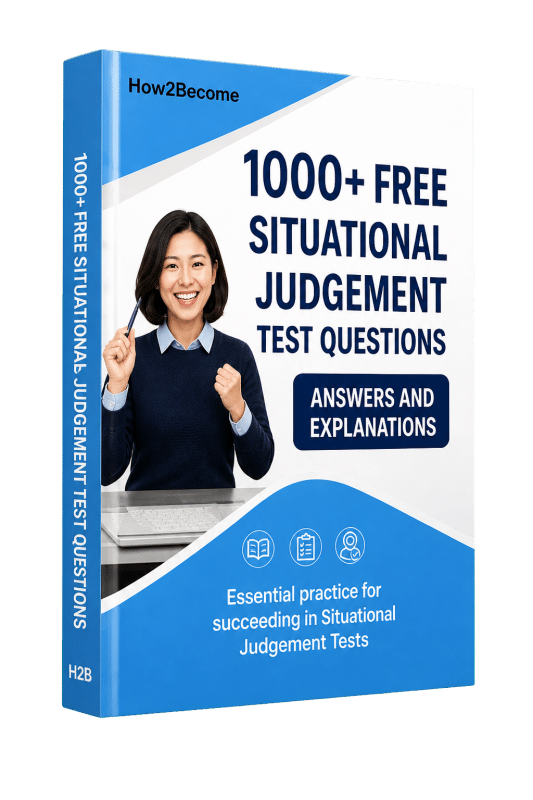
4. We will also provide you with over 1,000 Free practice download Situational Judgement practice test questions and answers, and other bonus download guides.
5. Also included is a 14 day Free Trial to our Situational Judgement practice testing suite, so you can practice mock SJT’s under timed environments.
THE CORE COMPETENCIES YOU WILL BE ASSESSED AGAINST
As you now know, having the core competencies is crucial to your success. So, the first stage of your preparation is to obtain a copy of them. These will usually form part of the job description and/or the person specification for the job.
Once you have them you should read them and learn them. This will then give you an understanding of the type of skills-set the employer is looking for. Here are a number of more common types of competencies assessed in UK-based organisations:
Integrity – The trust to act with honesty and treat all stakeholders (employee, external people) fairly and equitably, using open and transparent procedures.
Diversity – Diversity of the teams and take the best from people with different backgrounds to achieve the common goal of the organization.
Equal opportunities – Everyone should be treated following a policy of equal opportunities, without discrimination on any grounds such as sex, race, colour, ethnic, social origin, genetic features, language, religion or belief, political view, membership of a national minority, property, birth, disability, age or sexual orientation.
Respect – Equal treatment of all people working in the organization, following the rules and procedures.
Ambition – Organisations strives to constantly improve and obtain positive results. People have to be innovative, dynamic and committed to achieve their full potential.
Responsibility – Individuals must be capable of managing their own time and projects in order to meet strict timeframes for projects that are set by Heads of Unit. It is the responsibility of each individual to work with the other members of the team to achieve all targets and projects.
Professionalism – At any time, people should adopt a professional behaviour; treat file and people in a fair and efficient manner, using best practices and ensuring quality and stakeholders’ satisfaction.
Quality – Organisations want to provide the best service to the clients in timely manner.
Flexibility – People should be open to flexibility and have the ability to adapt to working environment depending on the situation, the evolution of the organization and/or the external environment.
Fight against harassment – Any forms of harassment (sexual, physic or mental) is strictly prohibited. Each person has the right to work in a safe and secure environment.
Transparency – For public organisations, the procedures should be transparent and open.
TIPS TO HELP YOU PREPARE FOR YOUR SITUATIONAL JUDGEMENT TEST:

TIP 1 – PRACTICE LOTS OF DIFFERENT SJT
The most effective way to prepare for a SJT or any other is test is practice. In the build-up to your SJT, embark on intense period of undertaking practice tests, to ensure you are as prepared as you possibly can be.
There are four main types of SJT’s you could encounter during your SJT, including the following:
- Best Answer: This type of SJT will present you with a scenario and you will be tasked with choosing the most appropriate answer only.
- Best and Worst: This variation of SJT will present you with a scenario and ask you to identify what you think is the best and worst response.
- Rank Each Response: In this challenging variation of the SJT you will be asked to rank each response from best to worst.
- Sliding Scale: Similar to the ‘Rank Each Response’, you need to assess which ranking to a sliding scale for each response. The main difference is that each answer does not need a differnt ranking for each answer. If you think that two options are equally ineffective you should rank as such.

TIP 2 – MATCH THE COMPETENCIES TO THE QUESTIONS
Although no prior knowledge of Situational Judgement Tests (SJTs) is required, it is important to understand how they relate to the role. SJTs assess whether your judgement, behaviour and decisions reflect the key competencies needed for the position, such as teamwork, communication, integrity, leadership and problem-solving.
Before taking the test, review the job description and identify the qualities the employer values. You should also understand how the test will be assessed, as you may need to select the best response, identify the least effective action or rank several options. Knowing the format and assessment criteria will help you approach each scenario confidently and demonstrate sound professional judgement.

TOP TIPS
Get a good night’s sleep
In the build up to your test get plenty of good quality sleep. If you are feeling tired and grouchy on the day of your test then you will not perform to your optimum ability.
Don’t give up
If you think you’ve performed poorly on a particular test try to put it behind you. The SJT is just one part of the entire selection process and you may be able to gain better scores in the other testing areas.
Practice plenty!
It is crucial that you practice plenty of SJTs before the real test in order to gain the highest scores possible. Always aim for 100% in your situational judgement practice tests.
Competencies
Understand the competencies you are being assessed against, and be able to identify which competency each question is referring to and answer each one accordingly.

PASS YOUR SJT WITH EASE…
- Instant Online Access
- 1000s of Practice Questions and Answers
- Practice Situational Judgement questions under timed conditions using our online testing suite
- Compatible on Mobiles, Tablets and Computers
- Scores are tracked so you can focus on areas that need improvement
- Get Free Access for 14 days, thereafter £9.99+ VAT per month, no minimum term.
Please note: After your trial expires the SJT package is automatically charged at just £9.99 plus vat per month with no minimum term. You can cancel anytime by contacting us at [email protected]. See our terms and conditions for more details.
GET INSTANT ACCESS NOW 👉Sample Situational Judgement Practice Test Questions
To help you get a better understanding of situational judgement tests, let’s take a quick look at a few sample questions.
QUESTION 1 AND ANSWER
You are a Project Leader and manage the coordination of four Team Members. Two Team Members won’t be able to meet the deadlines of the project. The Director of the organisation reminds you the importance of meeting deadlines. Which is the most likely course of action you would take?
A. Adapt the workload of all Team Members to respect the deadlines.
B. Discuss with the two Team Members that are having difficulties, identify the causes, evaluate the remaining workload and determine an action plan to finish the project.
C. Ask the two Team Members that are late, to work additional hours in order to respect the deadlines.
D. Inform your Director of the current situation of the Team Members that are having difficulties, so as to justify the status on the project, and ask for additional resources.
1. There are no right or wrong answers to SJT’s; however, your response will tell the employer how you are likely to perform in the role. In this particular question you are a ‘Project Leader’.
2. In order to decide the most effective way to answer this question you would have already studied and digested the core competencies for the role.
So, if one of the core competencies was ‘The ability to direct, lead and manage your team’s performance’, choosing option D would not be a good indication that you were capable of doing this.
However, if you were to choose option B (Discuss with the two Team Members that are having difficulties, identify the causes, evaluate the remaining workload and determine an action plan to finish the project), this shows that you are capable to managing the situation in order to come up with a positive solution.
Hopefully you are now beginning to see how important it is to learn, absorb and understand the competencies that are set out for the role you have applied for. If you learn them, we guarantee you will score far higher in the situational judgement test.
QUESTION 2 AND ANSWER
You have been assigned to work on a global project for your employer. You have to work with a member of another Unit. The Head of Unit has determined a fixed plan of action for each step. After a couple of weeks, you notice that your colleague on the project is not following the plan and his contribution is low, which is starting to have a negative effect on the project. Which is the most likely course of action you would take?
A. Wait for the contribution of your colleague on his work to pick up. In the meantime, you focus on your daily tasks.
B. Inform your Team Leader of the situation on the project, so that he reacts with the Team Leader of your colleague.
C. Send an email with a status report on the project, indicate what you did, with your Head of Unit in cc.
D. Discuss it with your colleague, ask him the reasons for the delay and fix up together a plan to continue on the project.
In order to demonstrate how to answer this question effectively, let’s assume that one of the core competencies for the role is:
“Responsibility – Individuals must be capable of managing their own time and projects in order to meet strict timeframes for projects that are set by Heads of Unit. It is the responsibility of each individual to work with the other members of the team to achieve all targets and projects.”
You will be able to concur from the above competency that the only correct answer to this SJT questions is D. By choosing this course of action you are working with the other member of the team to achieve the target for the project.

Pass your Situational Judgement Test. First time.
Crafted for everyone, no matter your skill level or background, this online testing suite was made to help you achieve one goal: to pass your SJT.
Scoring Criteria
Essential information about how you will be assessed during every stage of the selection process.
UP TO DATE FOR 2026
All questions have been verified by our assessment panel experts for the 2026 tests.
PRACTICE sITUATIONAL JUDGEMENT TESTS
Information on how to pass the tests including 1000s of practice questions and answers.
FULLY-WORKED SOLUTIONS
Fully-worked solutions for all questions so you can be confident in learning and improving your score.
INSIDER SECRETS
Insider tips on how to answer the SJT questions and a breakdown on how you will be scored.
SCORE-BOOSTING STRATEGIES
Get ahead of the competition with unique and proven strategies 16 years in the making.
Customer Success Stories
Having helped 1,000s of aspiring candidates for over 16 years, it is no wonder our customers love us…

Helped me pass my SJT so it’s a 5 star from me! Keep time trialing yourself to help improve your processing speeding.

Exactly what was needed for a young man hoping to get his dream job.

Thanks to this and continuous revisions, I passed my recruitment test! 😀

If you need to take a SJT or want more help with psychometric tests then this is worth buying.

I would definitely recommend this product it was good value for money & I’m sure my son wouldn’t of passed without it.
Did you know? All orders with How2Become are protected by our 30-day money-back guarantee (see our terms for full details).

WHAT’S INCLUDED WITH YOUR SITUATIONAL JUDGEMENT PRACTICE TESTS?

- 1000s of sample test questions to help you get ready for the situational judgement test.

- Questions that are guaranteed to be very similar to the ones you will actually sit during the real test. All SJT variations included.

- Advice and tips included that have been written by our recruitment and assessment experts.

- Created in conjunction with current Situational Judgement variations and methods.

- Up-to-date and relevant for the latest SJEs.

- Explanations to every question.

PLUS…BONUS!

BONUS
150-Page Interview Skills Insider’s Guide
FOR A LIMITED PERIOD ONLY we are able to give you our powerful 150+ page ‘Interview Skills’ guide free of charge. It is the perfect guide to help you prepare for the tough Royal Navy interview!
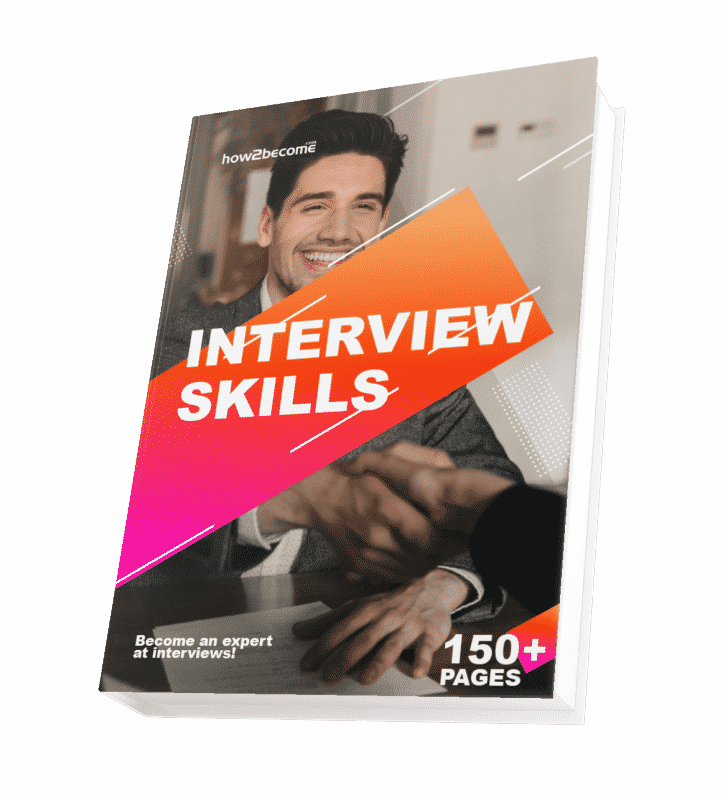
- All of the most common (and not so common) interview questions you are likely to face broken down.
- Full and detailed answers to every question – ensure you always have the perfect answer!
- How to use the STAR method to come up with your own winning answers that match the experience, values, and skills the interview assessor is looking for.
- Created by interview panel experts and packed full of insider advice.
Important: This insider’s guide cannot be purchased individually anywhere else and is exclusively available as a limited-time bonus!
Worth £9.99, Yours FREE
Download + Online Tests
Free Situational Judgement Practice Tests
Free for 14 days, thereafter £9.99 plus VAT per month. No minimum term.
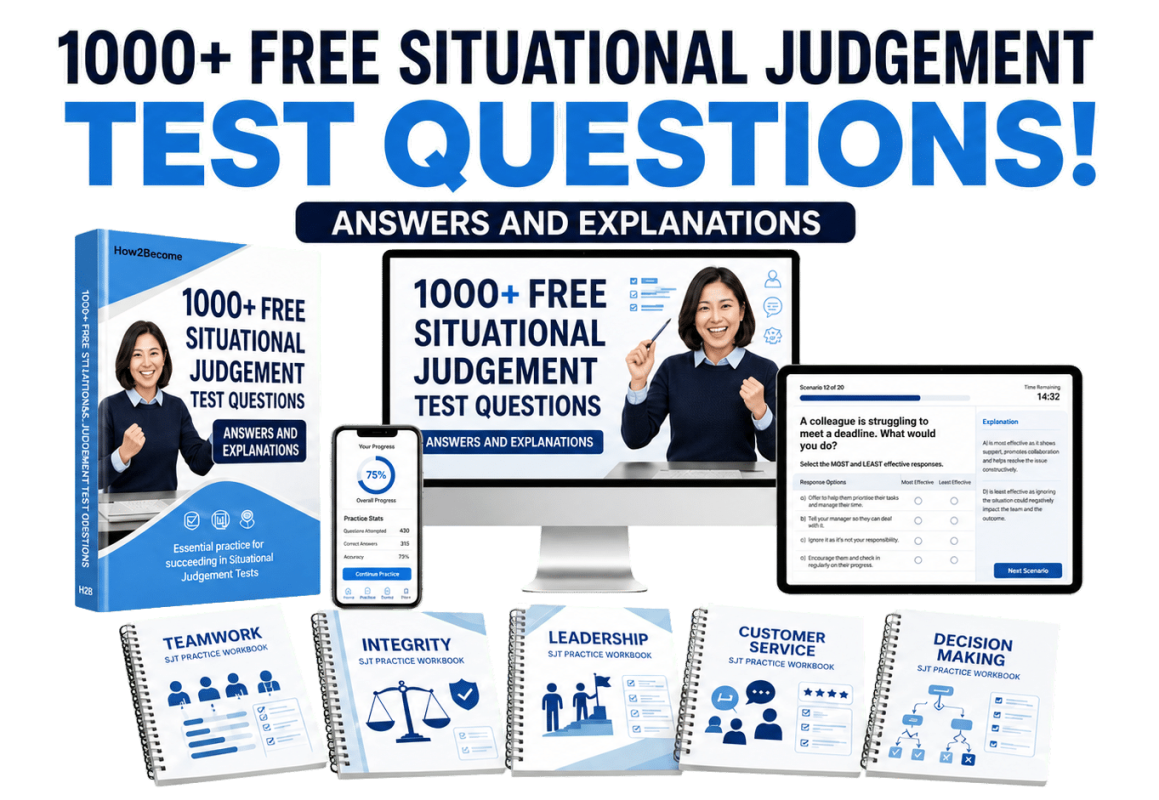
Includes:
✓ 1000s of Situation Judgement Tests for all job roles;
✓ All variations of Situational Judgement Tests included;
✓ Advice and tips included that have been written our recruitment and assessment experts;
✓ Practice under timed conditions using our online SJT suite;
✓ Includes stacks of bonus Psychometric testing guides and advice;
✓ Free access for 14 days, thereafter £9.99 plus VAT per month, with no minimum term;
✓ Cancel at anytime by emailing us at [email protected].
GET FREE ACCESS NOW
WHY BUY WITH HOW2BECOME?

CREATED BY THE EXPERTS

PROVEN TRAINING

EXCLUSIVE FREE BONUSES
Firstly, these guides are created by us and our team of experts – we have all the answers to your questions and will help you succeed (like we’ve been doing for the last 16 years), we update our material frequently and you can contact us at any time with any questions you have.
Secondly, we provide exclusive bonuses with all our products that you won’t find anywhere else. These bonuses include free guides, powerful online testing suites and more!
Finally, our guides and training just work. Take a look at our TrustPilot page where you will see our rating of 4.9/5. There, our customers share their positive buying experiences and more importantly the time-saving success our resources have given them (hint: they passed their RT).

Learn how to PASS SITUATIONAL JUDGEMENT TESTS
We’ve helped 1000s of aspiring applicants pass their across not only the UK, but throughout the world. Trust the UK’s #1 careers and education specialists to help you secure your role.
Get instant access »“Bought this for my daughter who will soon be taking a SJT, so far it has been very helpful, explains everything and how things are worked out. Definitely worth buying”