POLICE OFFICER OAC
MOCK COMPETENCY-BASED INTERVIEW PLATFORM

Practise under realistic timings, record your responses and receive detailed downloadable feedback.

Created to help police applicants practise with greater confidence:

1 MINUTE TO PREPARE

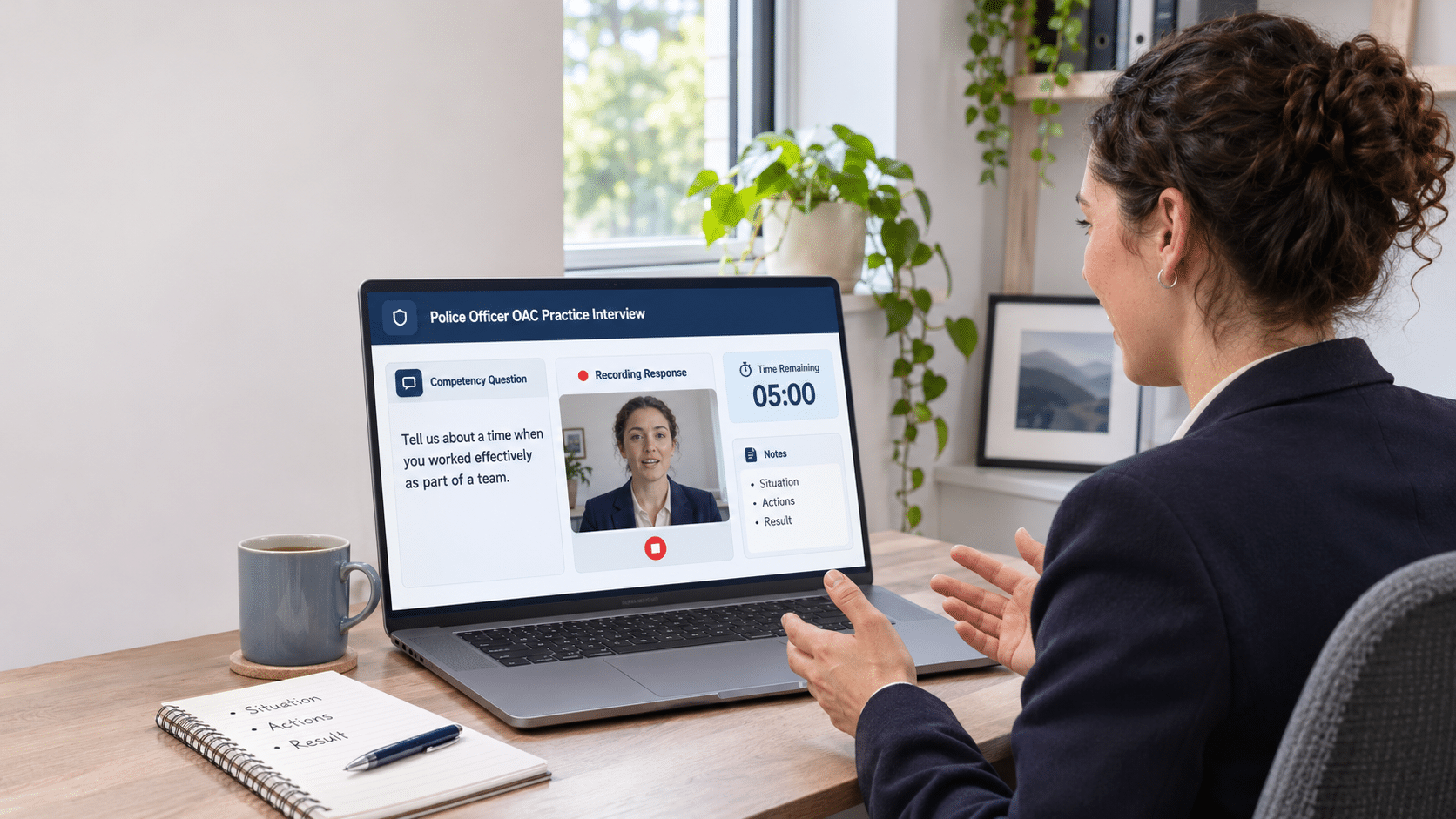
Read the question, organise your thoughts and make notes that remain available while you answer.

UP TO 5 MINUTES TO RECORD

Record your response on camera within the same time limit used for this stage of the online process.

DETAILED FEEDBACK

Submit your answer, review the analysis in your history and download your feedback for future practice.

PRACTISE THE POLICE OFFICER ONLINE INTERVIEW BEFORE ASSESSMENT DAY

Knowing what you want to say is only part of interview preparation. You also need to organise your thoughts quickly, speak clearly to camera and complete your answer before the time runs out.

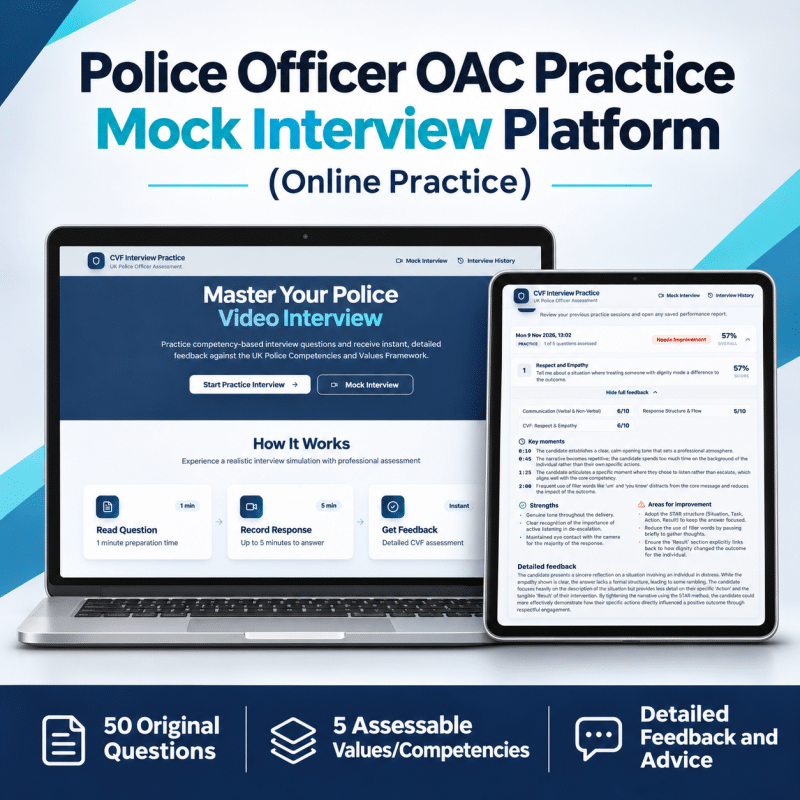
The Police Officer OAC Mock Competency-Based Interview Platform gives you a realistic place to practise the complete process. Each mock contains five different questions. For every question, you receive one minute to prepare and up to five minutes to record your response.

After you submit an answer, the platform analyses your response and places detailed feedback in your history. You can return to the feedback and download a copy to support your next practice attempt.

Practise the process, not a memorised script. Use the feedback to make each answer clearer, more relevant and better structured.

YOUR COMPLETE MOCK INTERVIEW JOURNEY

Question → 1-minute preparation → 5-minute recording → submission → detailed downloadable feedback

SEE THE FIVE ASSESSMENT AREAS

THE FIVE AREAS OF THE CVF COVERED IN EACH MOCK INTERVIEW

Each mock interview contains five different questions, with questions covering the following areas. The aim is to help you practise explaining what you did, why you did it, the outcome and what you learned, while keeping your answer focused on the behaviour being assessed.

COURAGE

Courage is about doing the right thing when a situation is difficult. Strong answers may show that you spoke up, challenged inappropriate behaviour, addressed a risk or made a considered decision despite pressure or uncertainty.

PUBLIC SERVICE

Public Service focuses on putting people and communities first. Your answer should show how you understood people’s needs, provided a reliable service, protected confidence and considered the wider effect of your actions.

RESPECT AND EMPATHY

Respect and Empathy involves listening, understanding different perspectives and treating people with dignity. It may include adapting your communication, recognising how someone feels and responding without making assumptions.

WE TAKE OWNERSHIP

We Take Ownership is about accepting responsibility and seeing an issue through. Strong examples show that you acted on a problem, kept people informed, dealt with challenges and learned from the result.

INNOVATIVE AND OPEN MINDED

Innovative and Open Minded focuses on being willing to learn, consider different ideas and improve the way something is done. Your answer may show that you questioned an assumption, invited other views or introduced a practical improvement.

The platform is designed for practice. Always follow the instructions provided by the police force or recruitment process you have applied to.

HOW THE MOCK INTERVIEW PLATFORM WORKS

The platform guides you through each stage. You do not need to manage a separate timer or recording application.

STEP 1: READ THE QUESTION AND PREPARE FOR 1 MINUTE

A competency-based interview question will appear on screen. You will have one minute to read it carefully, identify what it is asking and plan the main points of your answer. A notes box is provided so you can record useful prompts, such as the situation, the actions you took and the result. Your notes will remain available during the recording stage.

WAfter the preparation time ends, you will move to the recording stage. You will have up to five minutes to deliver your answer, just as you would during the real online interview. A visible countdown timer helps you manage your time, while your preparation notes remain on screen for reference. This allows you to practise speaking clearly, maintaining eye contact with the camera and giving a well-structured response under timed conditions.

Once you submit your recording, the system will analyse your response and produce a detailed performance report. The feedback covers the content and structure of your answer, your verbal and non-verbal communication, and how well you demonstrated the relevant competency or value. It will highlight your strengths, identify important moments in your recording and explain where your answer could be improved.

Your completed reports are saved in your Interview History, where you can review previous attempts and download the feedback for future practice.

Each mock interview contains five different questions, with one question assessing each of the following areas:

  • Courage

  • Public Service

  • Respect and Empathy

  • We Take Ownership

  • Innovative and Open Minded

The five-question format allows you to practise responding to a range of interview questions in realistic timed conditions. With 50 original questions available, you can complete further mock interviews, apply the advice from your feedback and work on improving your performance.

EacUse the feedback from each mock interview to improve your next attempt. Review your previous reports in the Interview History, compare your scores and identify any recurring areas for improvement. With 50 original questions available, you can complete further mock interviews, apply the advice you have received and build your confidence before the real assessment.

START PRACTISING NOW

Example “Tell Me About a Time” Question

Question: Tell me about a time when you took responsibility for resolving a difficult problem that was affecting other people.

Sample Answer

Situation: I was working at a community leisure centre when a fault with the online booking system caused two children’s activity sessions to be booked into the same sports hall. The problem was discovered on a busy Saturday morning when both groups began arriving.

More than 40 children and their parents were waiting, the instructors were becoming frustrated and the reception team did not know what information to give people. Some parents had travelled a considerable distance and had already started complaining.

If the problem was not dealt with quickly, both sessions might have been cancelled. This would have disappointed the children, placed colleagues under further pressure and damaged the centre’s reputation. There was also a safety concern because too many people were gathering around the reception area.

Task: I needed to take control of the situation, reduce the pressure on my colleagues and find a safe way for both sessions to go ahead.

I considered three options. We could cancel one session, delay both sessions while we waited for the sports hall, or move one group to another suitable area.

Cancelling would have been the easiest option, but it would have caused significant disruption. Delaying both sessions would have affected activities taking place later in the day. I decided that moving one session was the best option, provided another area could be used safely.

Action: I first checked the booking records and spoke to both instructors so I fully understood what each activity involved. I then informed the duty manager about the problem and explained the option I wanted to explore.

I identified an exercise studio that was not being used until later that morning. Before moving anyone, I checked its capacity, fire exits and available equipment with the duty manager. One of the sessions involved simple games and movement activities, so it could be delivered safely in the studio with a few changes.

I asked one colleague to help the instructor move the equipment while I spoke to the parents. I apologised, explained what had happened and told them exactly what we were doing to resolve it. I avoided blaming the booking system or other members of staff because my priority was to give people clear and reassuring information.

A few parents were still unhappy about the delay. I listened to their concerns and acknowledged that they had every right to expect the session to begin on time. I provided a realistic starting time and arranged for the café to offer water while they waited.

Once both sessions had started, I recorded the details of the affected bookings and contacted the organisation responsible for the booking system. I discovered that a room restriction had been removed during a recent update. I asked for the restriction to be restored and checked the following weekend’s bookings for similar problems.

I also produced a simple room-checking list for the reception team to use after future system updates.

Result: Both sessions went ahead safely, with one beginning approximately 15 minutes late. Most parents thanked us for finding a solution instead of cancelling the activity.

The booking fault was corrected that afternoon, and my checks identified another potential clash for the following weekend, which we resolved before customers were affected.

The duty manager introduced my checking list across the centre. This gave the reception team a clearer process to follow and reduced the likelihood of the same problem happening again.

Reflection: Upon reflection, I could have involved the instructors slightly earlier when considering the available rooms. Their practical knowledge helped confirm which session could be moved safely.

I also learned that taking ownership does not mean trying to do everything yourself. It means accepting responsibility for the problem, involving the right people, keeping those affected informed and making sure action is taken to prevent the issue from happening again.

Example “Hypothetical” Question

Question: Imagine you are a newly qualified police officer on patrol in a busy town centre. A member of the public approaches you and is visibly distressed. They say that the police never do anything about anti-social behaviour in their neighbourhood and accuse officers of not caring about local residents.

Part A: How would you respond to the individual initially?

Sample Answer

I would remain calm and avoid becoming defensive. Although the person is criticising the police, their frustration may come from repeated incidents and a feeling that nobody has listened to them.

I would introduce myself, acknowledge their concern and say something such as:

“I can see that this has had a real effect on you. I would like to understand what has been happening and what response you have received so far.”

If possible, I would move with them to a quieter and safer position away from the busiest part of the town centre. This would give them more privacy and make it easier for me to listen properly.

I would allow them to explain the problem without interrupting unnecessarily. I would use open questions to establish what has happened, where and when the incidents normally occur, who is involved and whether anyone is currently at risk.

I would also check whether the behaviour includes threats, intimidation, damage, violence, targeting because of a protected characteristic or concerns involving vulnerable people. If there was an immediate risk or a possible offence requiring urgent action, I would respond accordingly and request assistance if needed.

I would summarise what they had told me to make sure I had understood them correctly. I would record the relevant details and check whether they had previously reported the incidents or had any reference numbers.

I would explain honestly what I could do. I would not make promises about arrests or immediate outcomes before knowing the full circumstances. However, I would make it clear that their concerns would be recorded, reviewed and passed to the appropriate team.

Before ending the conversation, I would confirm what would happen next, how they could provide further information and what they should do if the situation became urgent.

Part B: What longer-term actions would you take to help rebuild trust and confidence with this resident and the wider community?

Sample Answer

After dealing with the immediate conversation, I would make sure the information was recorded accurately and shared with the neighbourhood policing team.

I would review previous incident reports, calls for service and any available intelligence relating to the location. This would help establish whether the problem was a series of isolated incidents or part of a wider pattern.

I would speak with colleagues who patrol the area and consider contact with relevant partners, such as the local authority, housing provider, youth services or community safety team. Anti-social behaviour often requires a joined-up response rather than action from the police alone.

I would support targeted and visible patrols at the times when incidents were most frequently reported. Where appropriate, I would also speak with local businesses and residents to understand the wider impact and encourage people to report incidents with useful details.

Any action would need to be fair and based on evidence. I would avoid treating every young person or group in the area as a problem. Engagement should include listening to young people and understanding whether a lack of facilities or other local issues is contributing to the situation.

Most importantly, I would ensure the resident received an update. Even if there had not been an immediate enforcement outcome, I would explain what had been reviewed, what action was being taken and who they could contact if the behaviour continued.

To rebuild wider confidence, I would encourage the neighbourhood team to provide appropriate community updates through local meetings, contact points or force communication channels. These updates should explain what the police and partner organisations are doing without sharing confidential information.

This approach would show the resident that their concerns had been listened to, recorded and acted upon. It would also help create a longer-term response based on evidence, partnership working and continued communication.


Don’t just prepare for the OAC Interview, experience it. Face realistic questions under the same time pressure, record your answers on camera and receive detailed feedback that shows you exactly where you can improve and ace your interview at the first attempt.

GET ACCESS TO THE MOCK INTERVIEW PLATFORM

What you’ll get…

Practice-test-questions-icon-

Realistic timed interview practice: one minute to prepare and up to five minutes to record each response.

Questions-and-answers-icon-

Five different questions in every mock interview, covering the five areas used by the platform.

Assessment-centre-panel-experts-icon-

On-camera response practice so you can improve your delivery, structure, clarity and time management.

Instant-access-to-test-questions-from-any-device-icon-

Detailed analysis after submission, showing the strengths of your response and the areas you should develop.

Online-aptitude-tests-training-course-icon-

A personal response history with downloadable feedback, allowing you to review previous attempts and plan further practice.

GET INSTANT ACCESS

Get Instant Access

Start a realistic Police Officer OAC mock competency-based interview and receive detailed feedback on your recorded responses.

  • 30-Day Money Back Guarantee
Visa
Visa Electron
MasterCard
Maestro
American Express

FREQUENTLY ASKED QUESTIONS

No. This is an independent practice platform designed to simulate the timed stages of an online competency-based interview. It is not part of a live police recruitment process and is not affiliated with or endorsed by the College of Policing or any police force.

Each mock interview contains five different questions. The questions cover Courage, Public Service, Respect and Empathy, We Take Ownership, and Innovative and Open Minded.

Yes. You have one minute to prepare and make notes. Your notes remain available for reference during the recording stage.

You have up to five minutes to record each response. You can submit earlier if you have completed your answer.

After you submit a response, the analysis and detailed feedback are available from your history. You can review the feedback online and download a copy.

You need a compatible internet-connected device with a working camera and microphone. Use a stable connection and test your equipment before starting a mock interview.

How2Become 30-Day Money Back Guarantee

30-DAY MONEY-BACK GUARANTEE

We want you to be confident in your purchase. This resource is protected by our 30-day money-back guarantee. If it is not right for you, contact us within 30 days in line with our refund terms.

WHY PRACTISE WITH HOW2BECOME?

Richard McMunn and the How2Become team have more than 20 years of experience creating recruitment and assessment preparation resources.

This platform has been created to give candidates a practical way to rehearse the interview process, not simply read about it. Timed preparation, on-camera delivery and feedback help you identify what to improve before assessment day.

No practice resource can guarantee an assessment result. Your aim should be to give honest, relevant answers that clearly explain your own decisions, actions and learning.

Expert-assessment-centre-coach-Richard-McMunn

WHAT CUSTOMERS SAY ABOUT HOW2BECOME

Read verified feedback about How2Become products and customer service. Reviews may relate to a range of How2Become resources and not specifically to this platform.

Important: This is an independent interview-practice resource. It is not affiliated with or endorsed by the College of Policing or any police force. Recruitment processes, timings and assessment arrangements can vary. Always follow the instructions in your invitation and the guidance provided by the force to which you have applied.