How2Become · Independent online preparation

POLICE IMMERSIVE
ASSESSMENT
PRACTICE & LEARNING

Put the tutorial into practice. Work through original neighbourhood scenarios, explore the reasoning behind different actions and build a more thoughtful approach to your preparation.

6 short lessons · 3 original cases · 36 actions with explanations · 4 reasoning puzzles

£9.99 + VAT per month (£11.99 including UK VAT).
Monthly subscription · 30-day money-back guarantee

Created by How2Become. Independent preparation; not affiliated with or endorsed by Police Now or any police force.

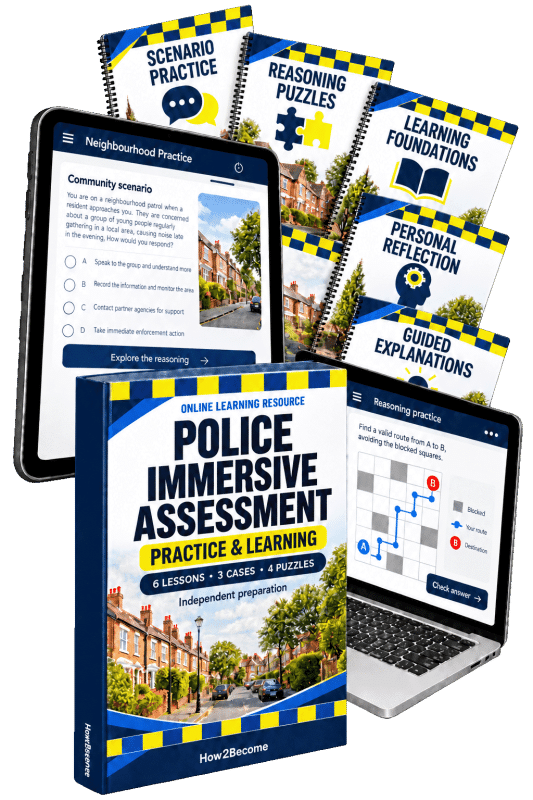
Police Immersive Assessment - Product Bundle

Online learning resource. Product illustration; printed books and devices are not included.

UNDERSTAND

Learn what matters

Explore listening, evidence, fairness and the realities of neighbourhood policing through six short lessons.

PRACTISE

Make a decision, then explore it

Consider 36 actions across three developing stories, with a teaching explanation for every action.

REFLECT

Take a useful next step

Explore your own motivations and working preferences, then download your personal learning plan.

Watched the video? Start here.

Knowing the advice is one thing. Applying it takes practice.

It is easy to say you would listen carefully, stay fair and check the facts. The challenge is recognising what that means when accounts conflict, new information arrives or a reassuring response promises more than it can deliver.

This interactive resource gives you space to slow down, consider a response and understand the thinking behind it. You will explore fictional community situations, practise planning a route through a puzzle and reflect on your own reasons for pursuing the role.

Every activity gives you something practical to work on before your assessment.

Your preparation, in one place

  • Short lessons with checks for understanding
  • Stories that develop across three chapters
  • Action ratings with clear teaching explanations
  • Path puzzles with hints and worked routes
  • Reflection prompts and a downloadable plan

SEE EVERYTHING INCLUDED

Inside the learning resource

Four ways to make your preparation count

Learn the principles, try them in context and take the learning forward.

01 / Learning foundations

6 lessons to build sound judgement

Learn to listen, separate facts from assumptions, recognise immediate needs, adapt communication, work with others and own mistakes.

Each lesson includes an everyday example, a common pitfall and a short check for understanding.

02 / Scenario practice

3 original cases. 36 actions to consider.

Explore Alder Quay, Willow Court and Market Lane. Each fictional case unfolds across three chapters as new information changes the picture.

Rate each action independently, reveal the teaching suggestions and understand why an action may help, miss something important or make matters worse.

03 / Reasoning workshop

4 interactive path puzzles

Read the rules, notice obstacles and plan your route before moving. Later puzzles introduce required stops to make you think further ahead.

Use hints, undo a step and compare your approach with a worked shortest route. Work at your own pace, without a countdown.

04 / Personal reflection

Your reasons. Your learning plan.

Work through eight prompts about motivation, working preferences, demanding aspects of the role and lessons from your own experience.

Choose a development goal and download your plan as a text file. Download before leaving: your notes are held only for the current page session.

Try the approach for yourself

What would you do with this information?

Explore these examples before you decide. The scenario and puzzle come from our original learning activities. Suggested ratings explain our educational judgement; they are not an official assessment answer key.

EXAMPLE 1: A COMMUNITY CONCERN — RATE THE ACTIONS

A concern at Alder Quay

An evening-class organiser says learners have started leaving together because a group near the bus interchange has been shouting at people. One learner has stopped attending. The organiser has heard about damage to a shop but did not see it. No injury has been reported to the organiser.

How effective would each action be? Rate each separately from 1 (very ineffective) to 5 (very effective). You do not need to use each rating once.

  1. Ask who is affected, what happened, when it happened and whether anyone needs help now.
  2. Promise that everyone gathering outside the interchange will be moved on each evening.
  3. Arrange a future community meeting, but leave the present concerns unexplored.
  4. Record the report, explain what information is still needed and agree how the organiser can receive an update.

Decide on your ratings, then open the explanation tab.

Our teaching suggestions

A — 5: Very effective. This acknowledges the impact, checks immediate concerns and gathers specific information without assuming that every reported incident has the same cause.

B — 1: Very ineffective. This promises an outcome before the facts, authority or individual behaviour have been established, and treats a whole group as responsible.

C — 3: Mixed / limited. A meeting may help longer-term understanding, but this response leaves current needs and the details of the reported behaviour unexplored.

D — 4: Effective. Clear recording and realistic updates can support trust. This should sit alongside checking immediate needs and understanding the incidents.

Takeaway: Take the concern seriously while keeping a clear distinction between what is known, what is reported and what still needs checking. Nearby ratings can be defensible; the reasoning matters.

In the full case, an outreach worker brings a different perspective and a later update challenges an early assumption. Explore how your response should develop with the evidence.

Find a route from A1 to D4

Move one square at a time, horizontally or vertically. You cannot use the blocked squares C1, C2 or B3. Aim to reach the finish in as few moves as possible.

Original practice puzzle. Rows run top to bottom; columns run left to right.
A1
START
B1 C1
BLOCKED
D1
A2 B2 C2
BLOCKED
D2
A3 B3
BLOCKED
C3 D3
A4 B4 C4 D4
FINISH

Trace a complete route before choosing the first move. Then open the worked route.

One shortest route uses 6 moves:

A1 → A2 → A3 → A4 → B4 → C4 → D4

The finish is three columns across and three rows down from the start, so reaching it requires at least six moves. This route achieves that without entering a blocked square.

Takeaway: Check the whole route. A move that looks promising on its own can lead to a dead end.

The full tool lets you select squares, undo moves, reveal hints and explore puzzles with required stops. Its step counts are learning feedback for our exercises.

What draws you to neighbourhood policing?

Take a moment to write your own answer. Think about prevention, public service and sustained community relationships. Which part interests you, and what experience helps explain that interest?

Then ask yourself: which realities of the role could I find demanding, and what do I still need to learn?

There is no model personality answer to copy. Use this exercise to understand your own preferences and reasons, and to decide what further information you need.

Build confidence in how you think.

Work through the complete stories, explore the explanations and put your learning into a practical plan.

YES – I WANT TO START PRACTISING

A simple way to get started

Step 1

Learn a principle

Start with a short lesson. Notice how the example connects an everyday action to listening, fairness or careful thinking.

Step 2

Try it in a situation

Explore a case and consider each action before revealing the explanation. Notice which details change your judgement.

Step 3

Choose your next step

Try a puzzle, reflect on your own experiences and download a learning plan with one specific thing to practise next.

Explore customer experiences with How2Become

These are company-wide reviews of How2Become products and services, rather than reviews specifically of this new resource.

Your next step after the tutorial

Get Police Immersive Assessment
Practice & Learning

Original activities. Clear explanations. Preparation you can put into practice.

Police Immersive Assessment - Product Bundle

The complete online learning resource

Police Immersive Assessment
Practice & Learning

£11.99 / month

Monthly subscription. Renews monthly until cancelled. To cancel, email [email protected].

  • 6 learning lessons with examples and checks for understanding
  • 3 original fictional cases across nine chapters
  • 36 actions to rate, each with a teaching explanation
  • 12 interactive reasoning puzzles with hints and worked routes
  • 8 reflection prompts and a downloadable learning plan
  • Official guidance links to support your preparation

START MY MONTHLY ACCESS

Use the access instructions provided with your purchase to sign in to the online resource.

30-day money-back guarantee. If the resource isn’t right for you, contact [email protected] to request a refund under our 30-day, no-questions-asked guarantee.

Independent educational practice. This resource does not predict results or guarantee selection.

Your questions answered

Who is this resource designed for?

It is designed for people preparing for a neighbourhood-policing immersive assessment who want original activities to practise judgement, careful reasoning and honest reflection. The learning was developed with applicants to Police Now’s neighbourhood route in mind.

Other police recruitment routes use different assessments. Check your invitation and the recruiting organisation’s guidance before deciding whether this resource fits your needs.

No. This is an independent How2Become educational resource. It is not affiliated with or endorsed by Police Now, Talogy, the College of Policing or any police force.

The cases, puzzles and teaching explanations are original practice material. They do not reproduce live assessment questions or official marking schemes. Use the resource before your assessment, and follow the organiser’s instructions when completing it.

The reflection activities help you explore your genuine motivations, working preferences and development needs. They do not provide an ideal personality profile or scripted answers to copy. Answer a real assessment honestly, in your own words and according to its instructions.

This product is a self-paced online learning tool. It includes text-based fictional cases, interactive puzzles, short lessons and reflection. It does not include actor-led videos, live role plays, a full assessment-centre simulation or a pass/fail result.

The online immersive assessment and the later assessment centre are different stages. For this route, start with Police Now’s official immersive-assessment guidance and your own invitation.

You use the resource online in a web browser. It is designed to adapt to desktop and mobile screens; a larger screen can make the case information and puzzle grids easier to explore.

The product picture illustrates the different learning activities. No printed books, devices or physical materials are included.

Access costs £9.99 + VAT per month (£11.99 including UK VAT at 20%). This is a monthly subscription that renews until cancelled. To cancel, email [email protected].

Your purchase is covered by our 30-day, no-questions-asked money-back guarantee. If this resource is not right for you, contact the same email address to request a refund under the guarantee.

Case responses are kept within the current activity session and are not submitted to a tutor or recruiter. There is no cloud-saved progress record.

Your reflection notes are held on the reflection page during that session. Use Download learning plan to keep a text-file copy before you leave or reload the page. Returning later will not restore those notes.

Read the current instructions in your invitation, check your equipment and use any familiarisation provided by the recruiting organisation. Contact its recruitment team about adjustments or access needs.

Police Now’s current public guidance describes cognitive, motivational and personality components. Formats and arrangements can change, so your own invitation and current official guidance take priority over any third-party preparation material.


Turn what you have watched
into something you have practised.

Explore the cases. Understand the explanations.
Take a clearer next step in your preparation.

GET POLICE IMMERSIVE ASSESSMENT PRACTICE

Created by How2Become. Original educational material for independent preparation.