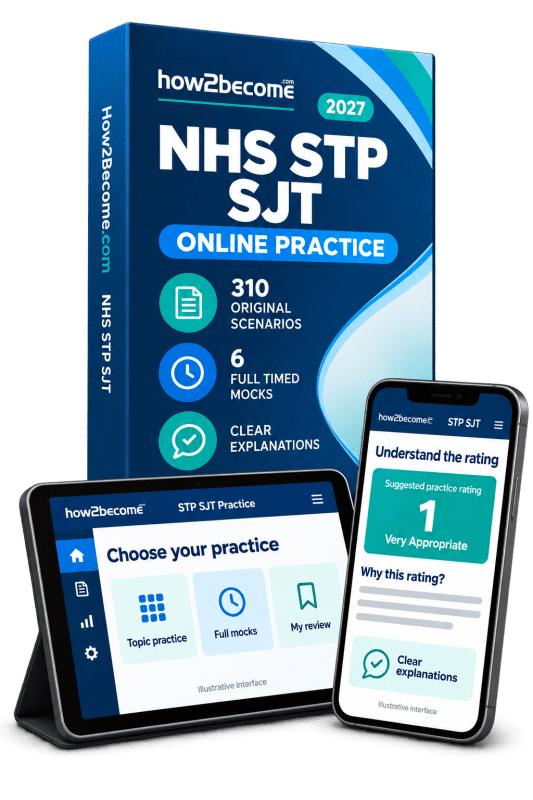
NHS STP SJT ONLINE PRACTICE
QUESTIONS & CLEAR EXPLANATIONS!
310 Original Scenarios • 6 Full Mocks
Read reviews of How2Become from our wider learning community:



310 Original Scenarios • 6 Full Mocks
Read reviews of How2Become from our wider learning community:












Preparing for the NHS Scientist Training Programme Situational Judgement Test? Knowing that an action sounds reasonable is only the start. The challenge is deciding how appropriate it is in the situation you have been given — and explaining why one rating fits better than the next.
Our focused STP SJT practice resource helps you work through those decisions. Practise original healthcare-science scenarios, rate each response independently, then study explanations that identify the deciding fact and compare nearby ratings. Build understanding you can apply when the next situation looks different.
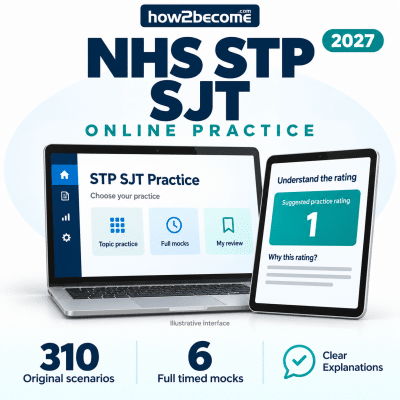
Work through 310 original scenarios and 1,276 explained response ratings, including six full mocks and 160 separate topic-practice scenarios. Start with short sessions, learn from the reasoning, and use timed mocks to practise maintaining your pace.
Your online resource brings the practice and learning tools together in one place:
UNDERSTAND THE RATING. EXPLAIN YOUR CHOICE.
Two responses can both be appropriate. Several actions can receive the same rating. An action can also be appropriate even when further steps will be needed. Our practice is built around judging each response on its own merits, with explanations that help you recognise what matters in the scenario.
The current published STP SJT format is 25 scenarios in 50 minutes, with four to eight responses per scenario. You rate each response independently on a five-point appropriateness scale. Always check the current NSHCS guidance and official sample-test information for your recruitment year.
Approach each scenario from the trainee role described. Read the facts carefully, consider the action itself, and keep these principles in mind:
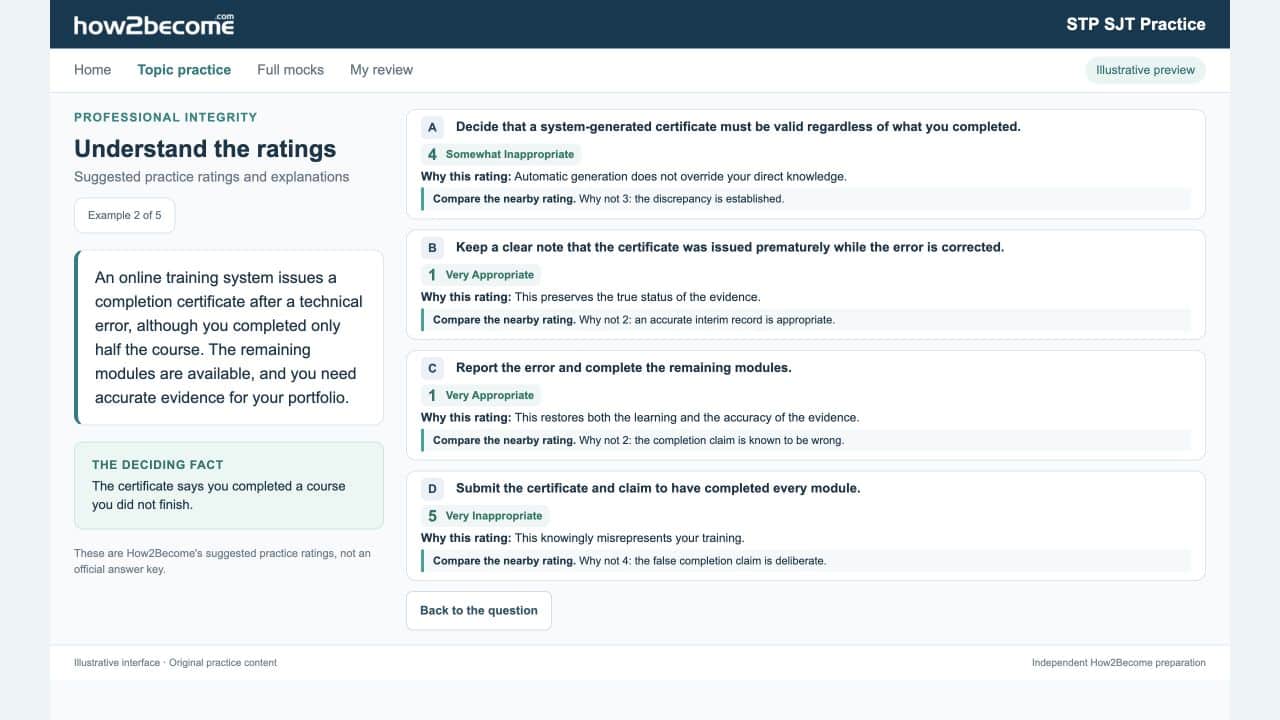
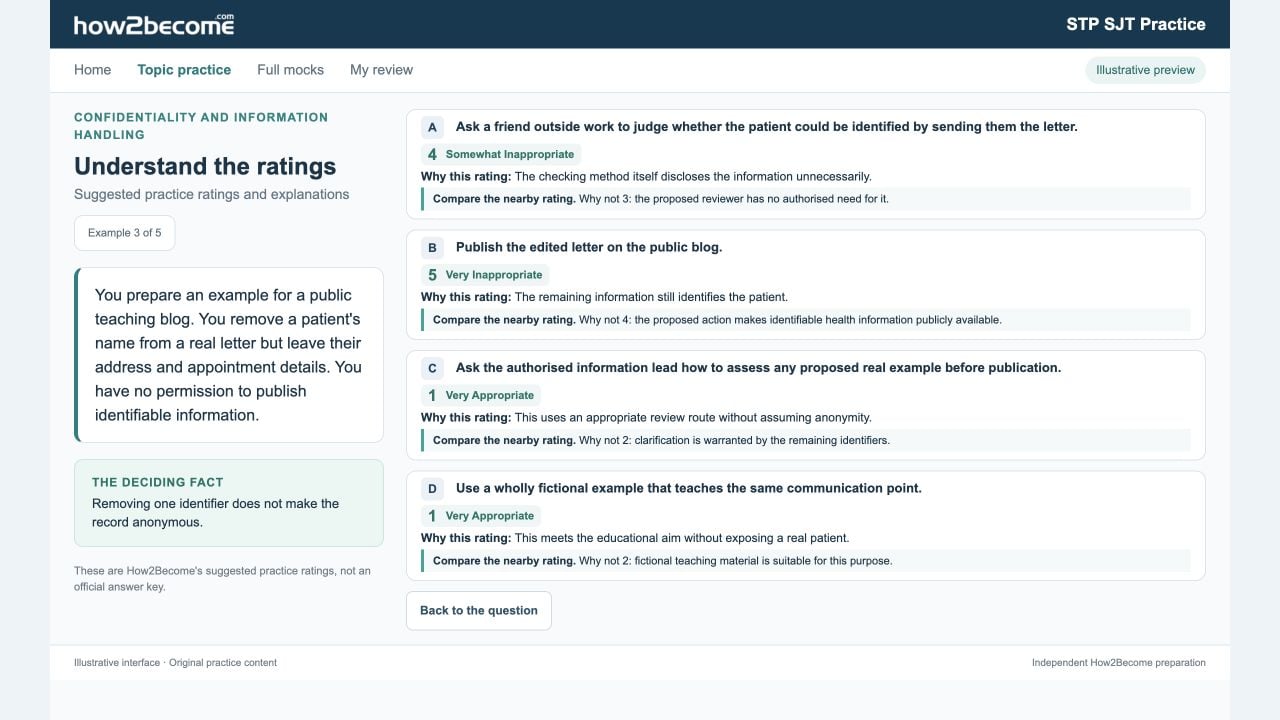
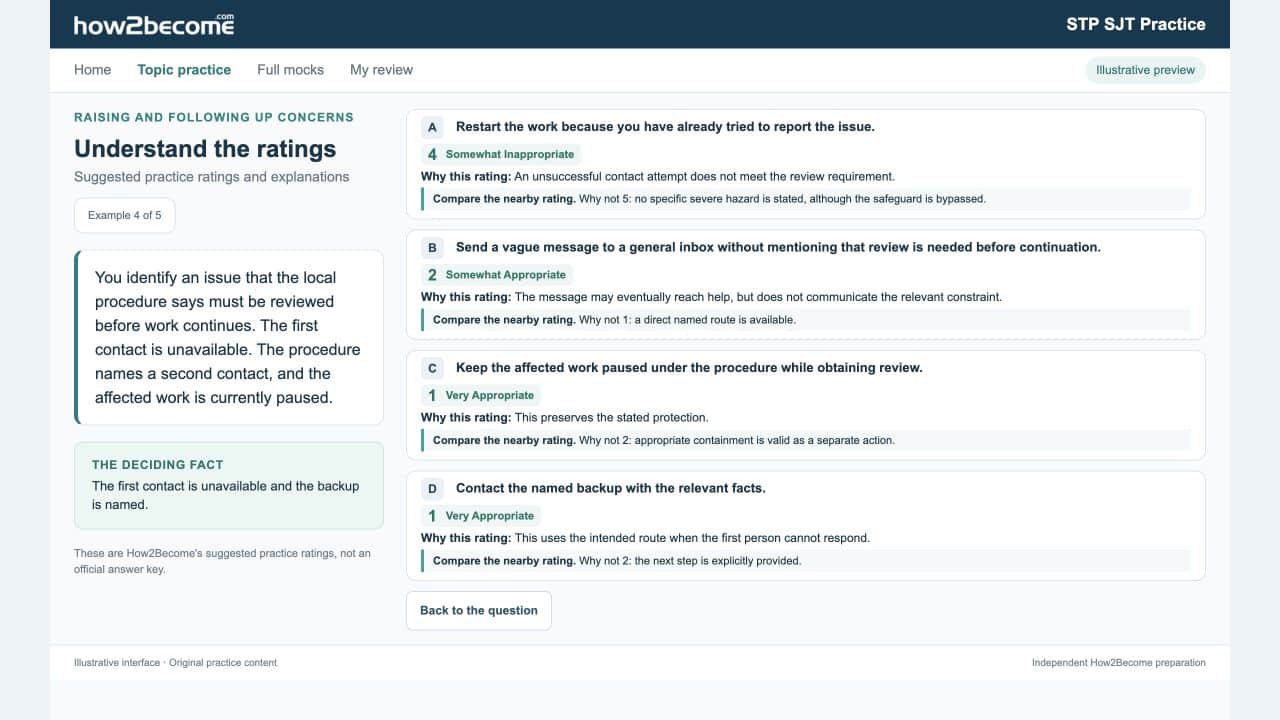
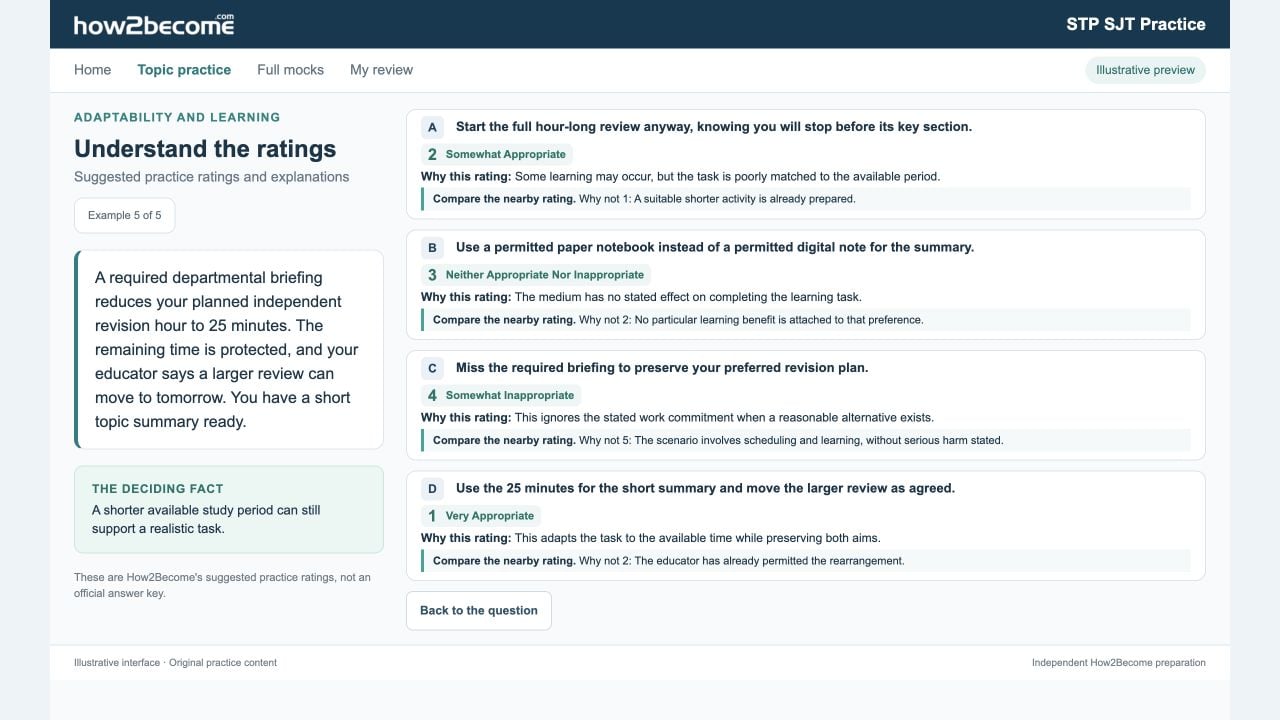
A suggested rating is most useful when you can see the judgement behind it. Our response explanations focus on two questions you can use during your review:
Which fact makes the difference?
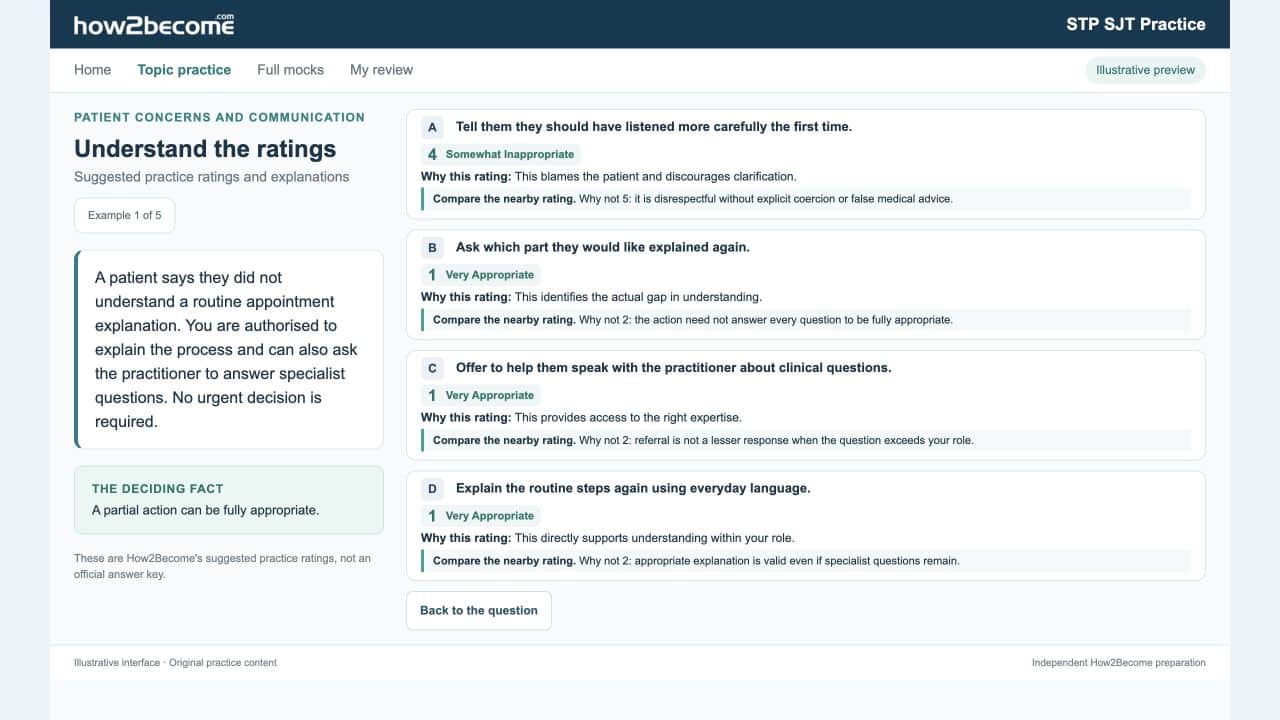
The scenario may tell you that you are authorised to explain a process, that a backup contact is available, or that work must remain paused. The explanation draws attention to that detail so you can understand why it matters.
Why this rating rather than a nearby one?
A comparison helps you explore the boundary between ratings. For example, asking a patient which part needs explaining may be very appropriate even though it does not, by itself, answer every question. Look for a weakness in the action before reducing its rating.
Use your preparation time to practise the decision and then review the reason. The included study plans give you 7, 14 or 28-day routes through the resource, and you can spend longer on any topic that needs attention.
STEP 1: Learn the scale. Read the short lessons and try a topic set without time pressure. Explain your choices in your own words before opening the suggested ratings.
STEP 2: Review the close calls. Compare your judgement with the explanation. Identify the deciding fact and work through the contrast exercises to see what changes when the circumstances change.
STEP 3: Practise your pace. Complete a full timed mock, then review the responses you found difficult. Use the official sample as well to become familiar with the assessment interface.
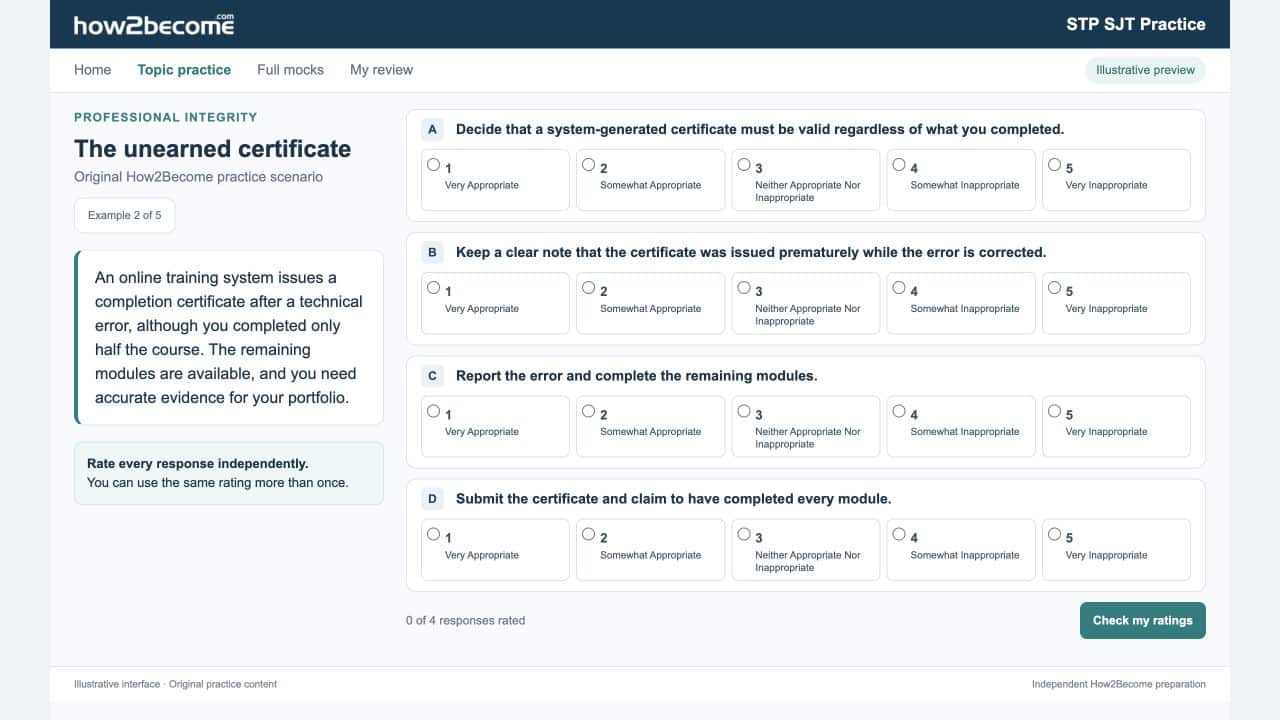
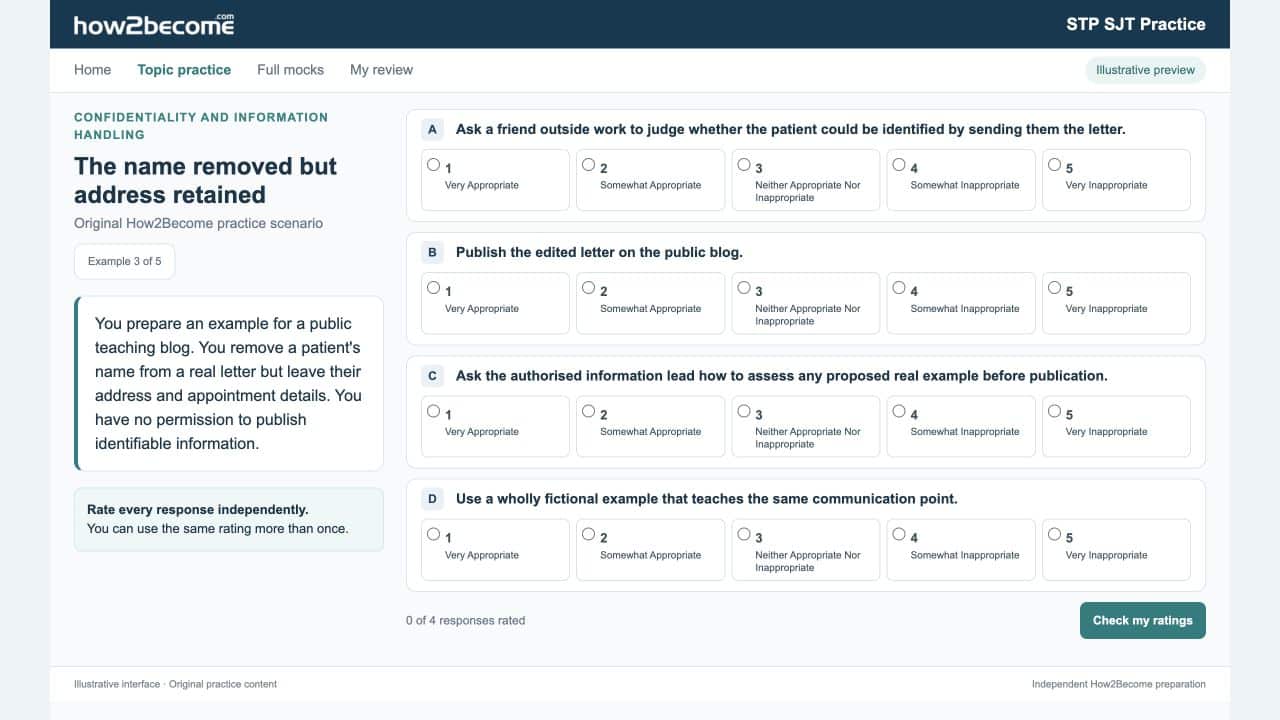
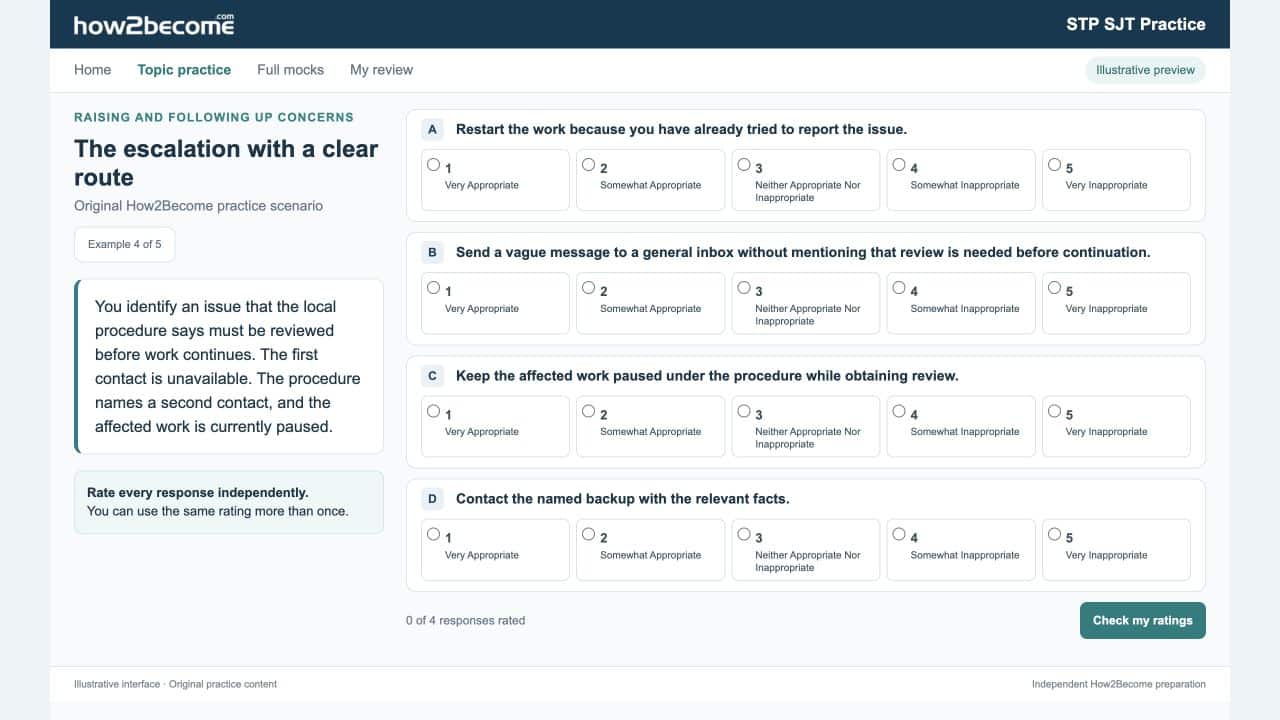
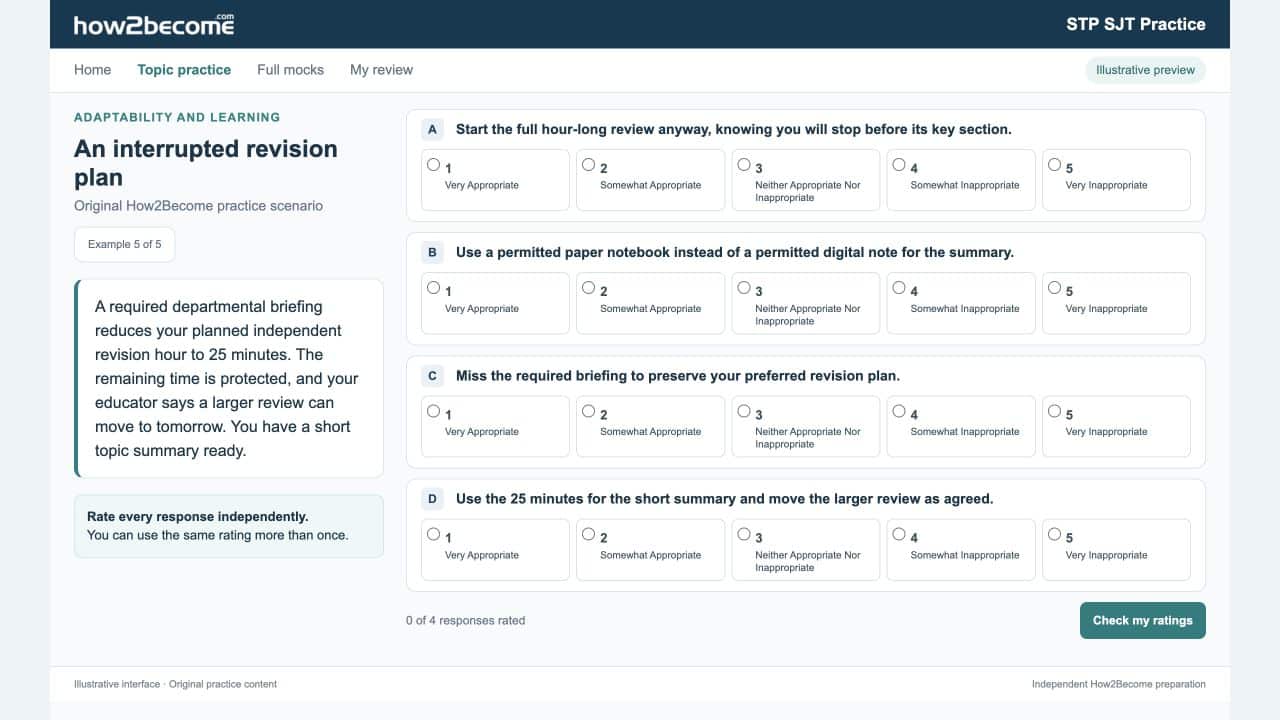
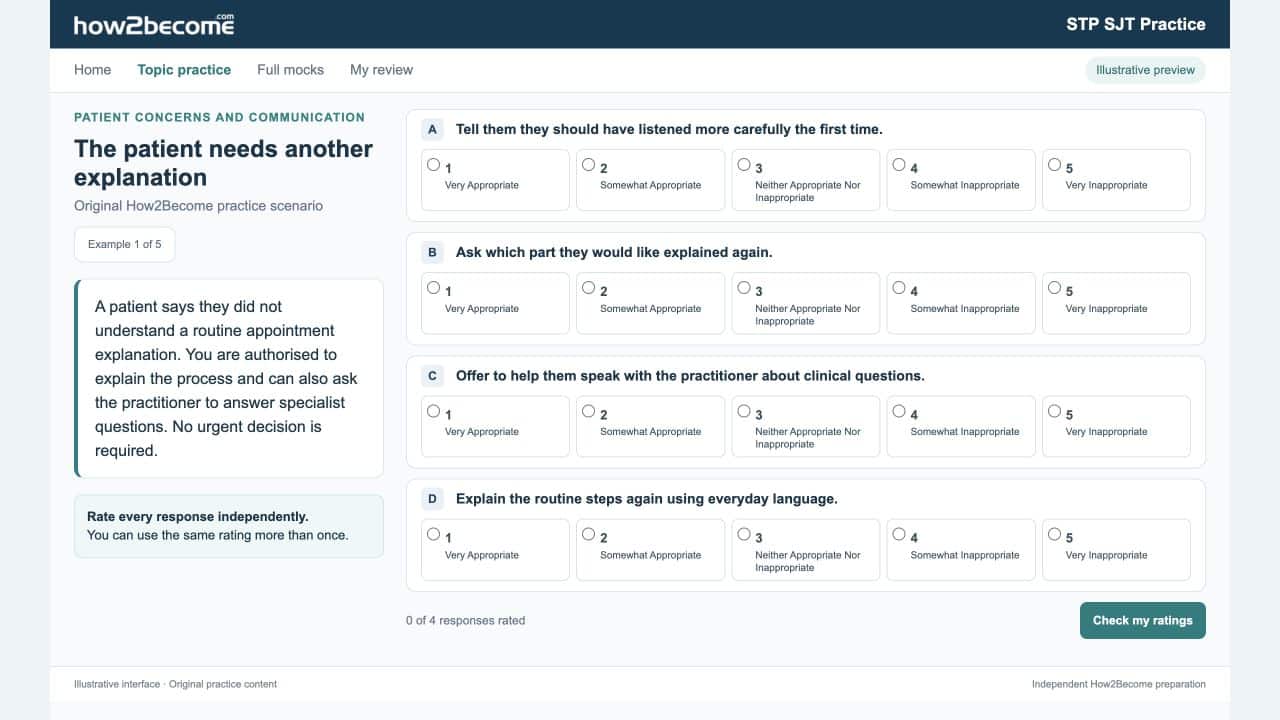
Try the five original scenarios below. Rate every response before opening the Answer tab, then compare the reasoning as well as the number. These examples come from the separate topic-practice bank, so your six full mocks remain fresh. The images are illustrative previews of the practice experience.
Get the full NHS STP SJT practice resource for £9.99 + VAT per month (£11.99 including VAT), with no minimum term.
Six full mocks, short topic practice and explanations of nearby ratings, accessed through your How2Become members area.
Now try two further situations. Look closely at the available escalation route and the stated work commitments: a small detail can make a different rating appropriate.
Get the full NHS STP SJT practice resource for £9.99 + VAT per month (£11.99 including VAT), with no minimum term.
Six full mocks, short topic practice and explanations of nearby ratings, accessed through your How2Become members area.
The published STP guidance identifies four attributes: empathy and compassion, professional integrity, team collaboration and adaptability. Use these as context for the trainee role, then pay close attention to what the scenario actually tells you.
Notice the concern being expressed. Consider whether the action listens, explains and treats the person respectfully.
Consider honesty, accurate records, appropriate handling of information and the responsibilities described in the scenario.
Look at the roles involved, the information colleagues need and the support or clarification available.
Consider whether the action responds constructively to a changed plan, new information or a need for support.
Identify the permission, constraint, urgency or available alternative that affects this particular action. Avoid inventing extra circumstances to justify a rating.
Ask what would make the nearby rating more suitable. The contrast exercises give you a structured way to practise this judgement.
Ready for more practice? Use the short lessons, eight topic areas and six full mocks to keep applying these ideas across different healthcare-science situations.
Build your NHS STP SJT preparation around 310 original scenarios, six full mocks and 1,276 explained response ratings. Understand why a rating fits, practise close calls and develop a more consistent approach.
Yes! I Want To Practise For My NHS STP SJT!These existing comments relate to other How2Become videos and resources, rather than this STP SJT product.

I have an assessment tomorrow evening! Kinda nervous but this training has made me more confident. Thank you! edit: I got the job on the spot!!!!! This video had the same exact questions!
How2Become community feedback

Have an assessment centre tomorrow and praying i'll also get it.
Update: Got the job! Thank you!
How2Become community feedback
I've got a online assessement with an investment bank coming up and would love to get the right list of questions for it 🙂
**I got the job!!** Thank you so much 🙏
How2Become community feedback

Thank you so much! I went today and got the job on the spot!
How2Become community feedback

...they made me take a basic vocabulary and typing test...I fortunately got a call back the next day saying I got the job!
How2Become community feedback

I have my test tomorrow...
UPDATE: I'm Hired♥️♥️ I am so happy 😊😊😊😊
How2Become community feedback

Richard, After getting myself trained from your tutorials , I GOT THE BEST JOB IN AUSTRALIA 🙂 . I have to say that I cracked my assessment for a Big company because of your lessons. A big thanks to you ,God bless you.
How2Become community feedback

...I'm so nervous! Hope these tips will help out :')
UPDATE: I got the job!!! These tips were so helpful thank you!
How2Become community feedback

I am sooooo NERVOUS! ...Fingers crossed 🤞🏾
UPDATE: I GOT THE JOB! 🥂🍾
How2Become community feedback

Thanks to you I got the job. THANK YOU SO MUCH❤️
How2Become community feedback
Thank u very much this helped me in my college entrance tests!
How2Become community feedback

I just want to say thank you. I went to sit my test yesterday and I passed. I practiced ur test questions and it made me feel really confident!
How2Become community feedback
GIVE YOUR NHS STP SJT PREPARATION A CLEAR STRUCTURE: PRACTISE, UNDERSTAND AND REVIEW.
310 ORIGINAL SCENARIOS • SIX FULL MOCKS • EIGHT TOPIC AREAS • CLEAR EXPLANATIONS
£9.99 + VAT PER MONTH (£11.99 INCLUDING VAT). NO MINIMUM TERM.
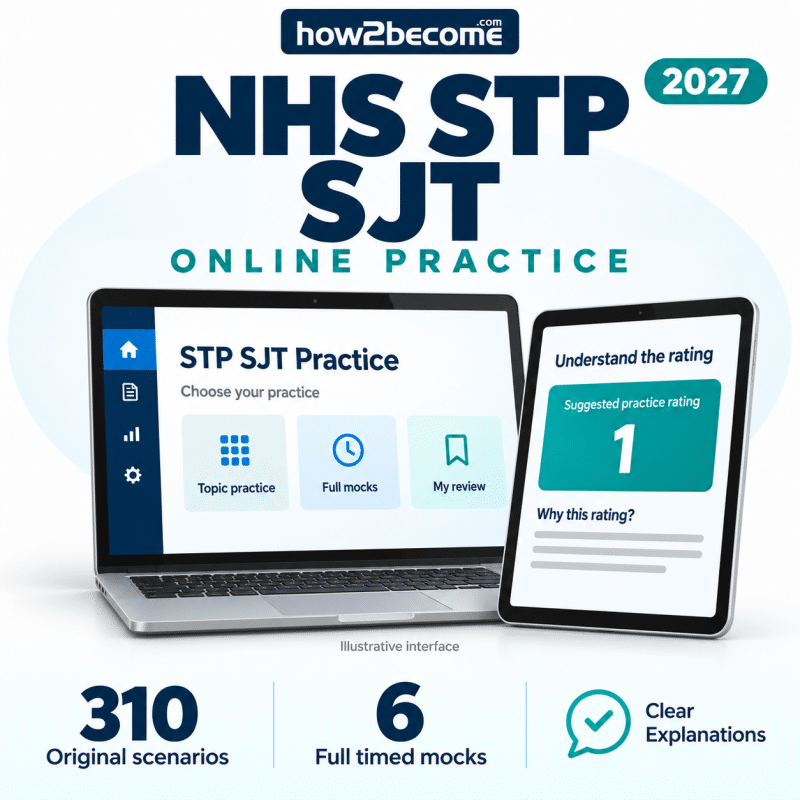

310 original healthcare-science scenarios. Six full mocks contain 150 scenarios, with a further 160 in the topic-practice bank. Work on teamwork, professional integrity, patient concerns, escalation, confidentiality, trainee responsibilities, adaptability and inclusion.

1,276 explained response ratings. Review the suggested rating, the specific reasoning and a comparison with a nearby rating. Learn what makes the judgement different when two numbers both seem plausible.

Lessons that make the reasoning easier to apply. Use 12 short lessons and 20 contrast exercises to learn the scale, focus on the deciding facts and explore how a changed circumstance affects the rating.

Online practice through your members area. Work through short topic sets when time is limited, then use full timed mocks for a longer session. Open the resource in a supported web browser on your preferred device.

A plan for the preparation time you have. Choose a 7, 14 or 28-day study plan to organise your lessons, practice and review. The plans reuse the included content, so you always know what is in the resource.
Your membership costs £9.99 + VAT per month (£11.99 including VAT) and renews monthly until cancelled. If you no longer need the resource, email [email protected] to cancel. Please read our subscription terms before ordering.
Why do the explanations make the difference?
A rating gives you the outcome. An explanation helps you understand the decision. Each response in this resource has a suggested practice rating, a rationale and a comparison with a nearby rating.
Start with the deciding fact. Look at the authority, information, available support or constraint in the scenario. Then compare what the action does with what a nearby rating would imply.
Use the reasoning in your next practice session. The questions are original How2Become preparation material. Links to published professional principles provide context for the explanations; they do not turn our suggested ratings into an official answer key.
Make each practice session count.
Practise the right decision. The resource is focused on STP-style independent response ratings, with healthcare-science scenarios and a consistent five-point scale.
Understand the close calls. Read why an action receives its suggested rating and compare it with a nearby alternative. The contrast exercises help you explore how the same action can be judged differently when a fact changes.
Choose the session that fits your day. Work through a short topic set, revisit a lesson or complete a full mock. Use the study plans to connect practice with purposeful review.
Keep the commitment flexible. Get monthly access for £9.99 + VAT (£11.99 including VAT), with no minimum term. Your subscription renews monthly until you cancel by emailing [email protected].
Read independent customer feedback about the wider How2Become business. These reviews cover a range of products and services and are not STP SJT pass-rate evidence.