NHS GMTS ASSESSMENT CENTRE TESTS PLATFORM
QUESTIONS & ANSWERS!

(450+ Sample Questions & Answers)

Trusted by 1000s of students worldwide:

How2Become-Guideance-Since 2005-Icon
How2Become Aptitude Test Questions & Answers Practice Tests 03
How2Become Aptitude Test Questions & Answers Practice Tests 04

The NHS Graduate Management Training Scheme, often known as NHS GMTS, is one of the most competitive graduate schemes in the UK. It is designed for candidates who want to build a career as future leaders in healthcare management, working across services that directly affect patients, staff, communities, and the wider NHS. The scheme looks for people with strong potential, sound judgement, self-awareness, resilience, and a genuine commitment to public service.

The GMTS recruitment process is not based only on academic achievement or previous work experience. The NHS states that its process is designed to assess candidates’ strengths, passion, and potential to become future NHS leaders. For the 2026 entry process, the official stages included the online Future Potential Assessment, the NHS GMTS Alignment Assessment, and a Virtual Assessment Centre for successful candidates.

ABOUT OUR NHS GMTS ONLINE ASSESSMENT PLATFORM

Our NHS GMTS Assessment Preparation Pack helps candidates understand what each stage is assessing, practise the types of questions they may face, and build confident, structured responses that reflect NHS values, leadership potential, and motivation for the scheme.

Included in the online platfom is multiple practice tests on every stage of the GMTS selction process from both the future potential and alignment assessments. The folloiwng tests are covered:

  • Future Potential SJT
  • Future Potential Numerical Reasoning
  • Future Potential Verbal Reasoning
  • Alignment Assessment SJT
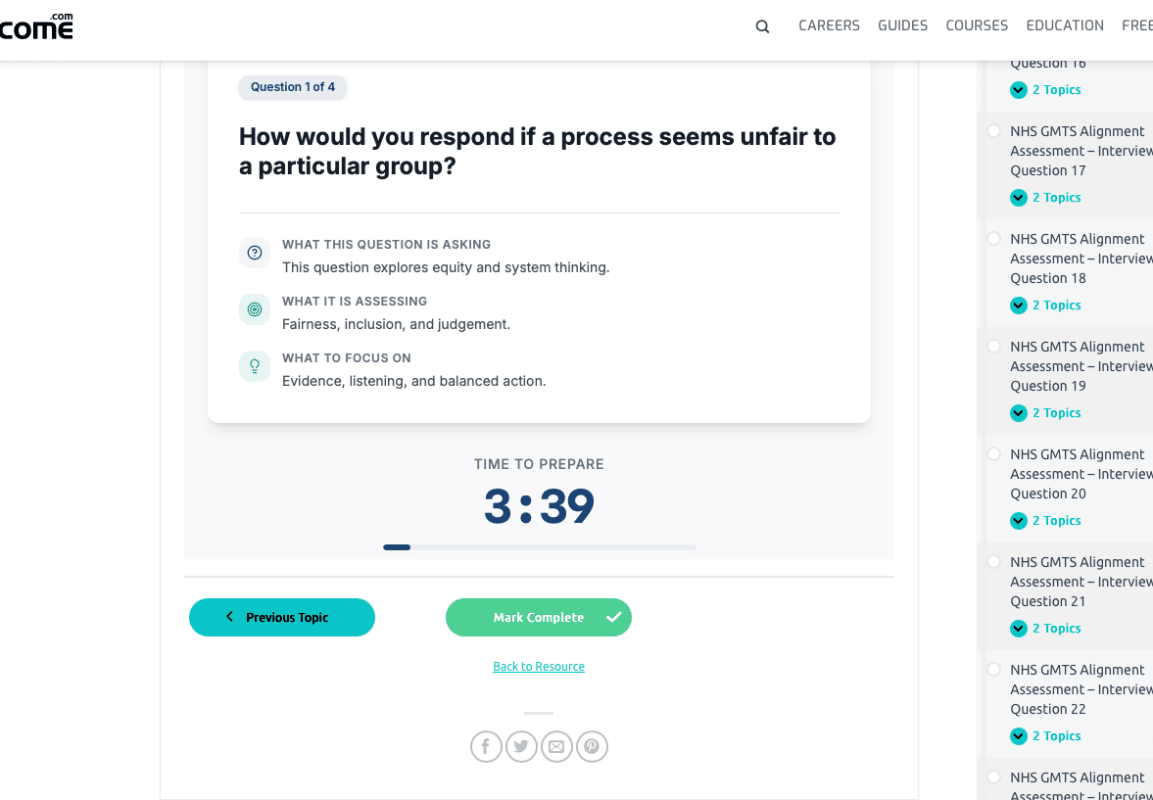
  • Alignment Assessment Interview Questions and sample answers
  • Now includes a Mock Interview platform where you can video your mock interview and download the video to analyse your performance.

ACCESS THE NHS GMTS ASSESSMENT CENTRE TESTS NOW
(CONTAINS 450+ QUESTIONS & ANSWERS!)

Learn More

NHS GMTS ASSESSMENT TESTS!

The NHS Graduate Management Training Scheme assessments are designed to identify candidates with the motivation, values, judgement, and future leadership potential needed to succeed in NHS management. The process usually includes a Future Potential Assessment, which explores how candidates respond to realistic workplace situations and make decisions, followed by an Alignment Assessment, which looks more closely at their personal motivation, communication style, strengths, and fit with the NHS GMTS. Together, these assessments give candidates the opportunity to show not only what they can do, but how they think, how they work with others, and how strongly their values align with the demands of leading services in a complex healthcare environment.

What is the NHS Future Potential Assessment?

The Future Potential Assessment is the first online assessment stage after registration and application. According to the NHS GMTS recruitment information, this stage takes approximately 45 minutes to complete, although it is not time limited. Candidates are also given the opportunity to practise each question type before starting the assessment.

This part of the assessment is designed to help identify whether a candidate has the potential, judgement, and working style needed for the scheme. It is likely to explore how you respond to realistic workplace situations, how you make decisions, how you approach competing priorities, and how naturally your strengths match the demands of NHS management. During this assessment you will encounter three types of questions:

  • Situational Judgement
  • Numerical Reasoning
  • Verbal Reasoning

What is the NHS GMTS Alignment Assessment

The NHS GMTS Alignment Assessment is the next online stage for candidates who pass the Future Potential Assessment. It includes two key exercises:

Situational Judgement Test

This exercise presents further workplace-based scenarios, often focused on values, leadership potential, working with others, responding to challenges, and making decisions that reflect the expectations of NHS management.

GMTS Alignment Interview

This is usually a video-based interview where candidates answer questions about their motivation, strengths, values, experience, and suitability for the scheme. It gives candidates the opportunity to explain why they want to join the NHS GMTS, how they align with NHS values, and how they would approach the responsibilities of a future NHS leader.

What is the best way to prepare for the NHS Assessment Tests?

In our experience, and having consulted several previous NHS GMTS applicants, the most effective way to prepare is to undertake numerous sample test questions under timed conditions. By practicing under timed conditions it enables you to improve your scores dramatically. When preparing for the NHS numeracy and literacy test, follow these 3 simple steps:

STEP 1: Obtain examples of NHS future potential and alignment assessment, SJT, Verbal and Numerical and interview questions. Read them and gain an understanding of the format. If you understand the style of questions you will have to answer, the real test will be less daunting.

STEP 2: Practice sample test questions regularly in the build-up to the real test. Little and often is far better than cramming the night before your test.

STEP 3: The most important step when preparing for your NHS GMTS assessment test is to make sure you practice the test questions under strict timed conditions. During the real assessment, you will undoubtedly be nervous. By practicing numerous multiple-choice example questions under tined conditions it helps to increase your speed of working and competency levels.

EXAMPLE NHS GMTS ASSESSMENT TEST QUESTIONS

Below, are examples of test questions that are designed to help you prepare for your NHS GMTS assessment tests. It does not matter if you are applying for a role in general management, HR, finance, Health Informatics, Policey & Strategy or Health Analysis, the following assessments are useful in your preparation. Look at the following questions and see how you get on:

NHS GMTS FUURE POTENTIAL TEST QUESTIONS

EXAMPLE SITUATIONAL JUDGEMENT TEST QUESTION

You are on a graduate placement in a national charity. The charismatic founder stepped down last year but remains on the board. The new CEO is trying to modernise governance.

At a recent board meeting you observe the founder:

Interrupting staff presentations to give personal anecdotes.

Pushing for pet projects that do not align with the agreed strategy.

Speaking directly to senior funders outside formal channels.

After the meeting, the CEO says quietly, “We need to shift this dynamic, but I can’t afford a public fallout. I’d like your honest view on what we might do.”

What do you advise? 

Choose the most and least effective responses.


A. Suggest commissioning an external governance review that includes board behaviour, using its recommendations to have a structured conversation with all trustees, including the founder.
B. Recommend that the CEO speak privately to the founder and tell them firmly to stop interfering in operational matters, relying on their personal relationship to carry the message.
C. Propose reducing the number of board meetings the founder is invited to, focusing their attendance on ceremonial events and keeping them away from strategy sessions.
D. Advise the CEO to accept the situation for now because challenging the founder could destabilise funding and morale; focus instead on strengthening the executive team’s confidence.

Answer

Most Effective: D

Least Effective: A

A – Least Effective sounds neat but risks the founder framing any review as an attack, and may drag out tension. It shows weak Structured Reasoning about personalities and high political cost.

B is direct and may be needed eventually, but puts all the risk on one conversation, with limited Innovative Problem-Solving about safer routes.

C is a quiet workaround that may trigger resentment when the founder notices; it dodges open discussion.

D – Most Effective recognises constraints and opts for gradual influence, building executive strength and waiting for a better moment to adjust dynamics. This is subtle Structured Reasoning and Sustained Commitment to organisational stability over quick wins.

You leave your house at 10:05. You travel for half an hour at 50 mph. When you reach the motorway, the traffic forces you to drive at 15 mph for 12 minutes. After the traffic clears, you continue your journey at 50 mph and arrive at your destination at 11:25.

How long would you have been travelling for if you had not got stuck in traffic, assuming you remained at 50 mph for the whole journey?


A. 1 hr 2 mins
B. 1 hr 5 mins
C. 1 hr 15 mins
D. 1 hr 12 mins

EXPLANATION = 1 hour and 12 minutes

→ If you drove at a constant speed of 50 mph for 60 miles, it would have taken you 1 hour and 12 minutes.

From: Director of Quality and Safety

To: Executive Quality Committee

Subject: Learning from Recent Near-Miss Reviews

Recent near-miss reviews indicate that established safety controls functioned as designed, preventing harm. However, analysis also shows that in several cases, these controls were activated later than would be considered optimal.

Some reviewers have therefore argued that the system is fundamentally safe, given that controls ultimately worked. Others have raised concern that repeated reliance on late-stage safeguards may mask weaknesses earlier in the process.

While there is no evidence of systemic failure, the pattern suggests an opportunity to strengthen upstream risk identification and escalation.

The Quality team recommends focusing improvement efforts on earlier intervention points, rather than expanding existing control mechanisms.

Which statement would be most misleading if presented to the Committee?

A. Safety controls prevented harm in recent incidents.
B. There is no need to change current safety arrangements.
C. Earlier detection could reduce reliance on late-stage controls.

D. Improvement efforts should focus on upstream processes.

Correct Answer: B

Explanation:

Although controls worked, the email clearly identifies improvement opportunities. Claiming no need for change would ignore the central message.
NHS Literacy Questions Locked

Purchase the full package below for just £7.99 to access the NHS Numeracy, Literacy, & Values Assessment Test workbook and get all of the questions and answers to help boost your employability with the NHS!

Well done if you managed to get all of the NHS GMTS Future Potential test questions correct. Now it’s time to try some NHS GMTS Alignment Assessment test questions detailed below:

NHS GMTS ALIGNMENT ASSESSMENT TEST QUESTIONS

EXAMPLE SITUATIONAL JUDGEMENT QUESTION

I am working in an NHS corporate office that supports non-clinical services, including finance, estates, and patient experience. The team is preparing a short internal briefing that will be shared with several departments to explain a forthcoming change to how requests are prioritised. The briefing is intended to be factual and neutral, and it will be used by managers to answer questions from their teams.

During a discussion about the wording, a colleague makes a light-hearted comment suggesting that the change will “finally stop people gaming the system.” The comment is not written into the briefing, but it is said in front of several colleagues, including someone from a service that has previously raised concerns about being treated unfairly. The conversation moves on quickly, and no one responds directly to the comment.

Later that day, the colleague who represents the service approaches me privately and says the comment made them uncomfortable. They explain that remarks like that reinforce a perception that their team is not trusted, even when they are following the same processes as everyone else. They do not want to make a formal issue of it but felt it was important to say something.

I am not responsible for managing either colleague, and the comment was not overtly offensive.

Choose the most and least effective responses

A. I reassure the colleague who raised the concern and take no further action.
B. I speak to the colleague who made the comment and explain how it was perceived.
C. I leave the situation alone as the comment was informal and brief.
D. I suggest tightening the briefing language to avoid misunderstanding.

Most effective response

I speak to the colleague who made the comment and explain how it was perceived.

Explanation (NHS Values):

This response best supports Respect and dignity by addressing the impact of the comment directly and proportionately. It aligns with Everyone counts, as it recognises how informal remarks can affect colleagues’ sense of fairness and inclusion. Handling the issue without escalation also supports Working together for patients, as it helps maintain constructive relationships across teams.

Least effective response

I leave the situation alone as the comment was informal and brief.

Explanation (NHS Values):

This response is least effective because it dismisses the concern raised and allows the impact of the comment to go unaddressed. Ignoring the issue undermines Respect and dignity and Everyone counts, as it signals that discomfort expressed by colleagues is not taken seriously. Over time, this can weaken collaboration, affecting Working together for patients.

Interview Question 1 – What motivated you to apply to the NHS GMTS?

Example Response

Applying to the NHS GMTS was a decision shaped by how I want to learn and where I want to make a difference. I am motivated by roles where decisions matter beyond internal targets, and where the impact of good organisation, clear communication, and fair decision making is felt by real people. The NHS operates at that level every day, and that sense of responsibility is something I am drawn to.

The structure of the GMTS also matters to me. The opportunity to rotate through different areas means learning how a large and complex organisation actually works, rather than seeing it from one narrow angle. I am someone who learns best by understanding how pieces fit together, where pressure points exist, and how small improvements can reduce frustration for staff and patients.

I am also motivated by the values led nature of the NHS. Working in an environment where fairness, respect, and quality are not optional but expected aligns with how I naturally approach work. I want to develop in a setting where decisions need to be balanced, explained, and justified, especially when resources are limited or priorities compete.

Ultimately, the GMTS appeals because it offers challenge, responsibility, and development within a public service context. It feels like a place where I can grow while contributing to something that genuinely matters.

Example Answer:

Applying to the NHS GMTS was a decision shaped by how I want to learn and where I want to make a difference. I am motivated by roles where decisions matter beyond internal targets, and where the impact of good organisation, clear communication, and fair decision making is felt by real people. The NHS operates at that level every day, and that sense of responsibility is something I am drawn to.

The structure of the GMTS also matters to me. The opportunity to rotate through different areas means learning how a large and complex organisation actually works, rather than seeing it from one narrow angle. I am someone who learns best by understanding how pieces fit together, where pressure points exist, and how small improvements can reduce frustration for staff and patients.

I am also motivated by the values led nature of the NHS. Working in an environment where fairness, respect, and quality are not optional but expected aligns with how I naturally approach work. I want to develop in a setting where decisions need to be balanced, explained, and justified, especially when resources are limited or priorities compete.

Ultimately, the GMTS appeals because it offers challenge, responsibility, and development within a public service context. It feels like a place where I can grow while contributing to something that genuinely matters.

Purchase the full package below for just £12.99 to access the NHS GMTS Online Assessment Platform and get all of the questions and answers to help boost your employability with the NHS GMTS scheme!

WHAT ARE THE NHS VALUES?

All NHS staff, regardless of the duties, are required to demonstrate the NHS values in their daily work. There are six NHS values that apply to all workers, including consultants, nurses, doctors, administrative staff, hospital porters, healthcare assistants, dental assistants and surgeons, laboratory technicians, and secretaries. The six NHS values are as follows:

Working together for patients

Patients must always come first in everything you do working in the NHS.

Everyone counts

Working in the NHS means maximising resources to make sure they benefit everyone. It will be your duty to ensure no person is discriminated against, excluded, or left behind. Inclusive working is very much at the heart of the NHS.

Respect and dignity

Without respect and dignity, the NHS would not be able to provide outstanding service and care. Respect and dignity apply to everyone, including patients, their family and relatives, contractors, suppliers, and work colleagues.

Improving lives

Every contact you have with a patient in the NHS should be used to improve their health and wellbeing. Working in the NHS is not limited to assessment, treatment, and care, it is about advice and education, too.

Commitment to quality of care

The highest standards of care must be maintained at all times in your NHS duties. You must seek to improve, learn, provide the right quality and standards of care, and work to earn the trust that has been placed in you by the patients.

Compassion

The NHS would not be the service it is today without compassion and empathy. NHS staff ensure that compassion, kindness, and understanding are central to everything they do.

To help you prepare for the NHS assessment process, including the tough NHS interviews, we have provided you with several NHS values workplace assessment test questions below. Give the questions a try and see if you can answer them correctly.

Now INSTANTLY access the NHS GMTS Assessment Centre Platform containing 450+ questions, answers and explanations. Plus full access to the GMTS Alignment Assessment Mock Interview practice platform!

Yes! I Want To Pass My NHS GMTS Assessment!

Here's What People Are Saying...

(worldwide success stories from our YouTube community!)

GET INSTANT ACCESS TO 450+ PRACTICE QUESTIONS AND FULLY-WORKED ANSWERS FOR THE NHS GMTS ASSESSMENT TEST!

PLUS ACCESS TO OUR NHS GMTS ALIGNMENT ASSESSMENT MOCK INTERVIEW PRACTICE PLATFORM

FOR JUST £12.99 PLUS VAT PER MONTH, NO MINIMUM TERM

What you’ll get…

Practice-test-questions-icon-

Access to 450+ NHS GMTS assessments suitable for both the Future Potential and the GMTS Alignment Assessment exercises designed to help you effectively prepare for the GMTS Assessment Centre!

Questions-and-answers-icon-

Fully worked solutions/answers to all of the questions to ensure you gain an advantage and pass.

Assessment-centre-panel-experts-icon-

Questions and answers verified by our panel of asssessment experts.

Instant-access-to-test-questions-from-any-device-icon-

Instant access to your tests and all of the practice questions from any device via instant download.

Online-aptitude-tests-training-course-icon-

Now available with our brand new Online Mock Interview Practice platform! Suitable for your allignment assessment this platform allows you to undertake mock interviews under timed conditions which records and allowances you to download the video, so you analyse your performance.

Order Now

Pass the NHS GMTS recruitment process today. Trusted by 10,000s of customers worldwide.

SILVER
450+ NHS GMTS ASSESSMENT CENTRE ONLINE TEST PLATFORM
INSTANT ACCESS
£27.99 £12.99 per month + VAT
YOU SAVE 55%

✓ Instant Online Access to over 450 NHS GMTS AssessmentS
✓ Fully up-to-date for the 2026 NHS selection process!
✓ Includes both the Future Potentional and GMTS Alignment assessments
✓ Over 450 Questions covering SJT, Numerical Reasoning, Verbal Reasoning, test questions, designed to help you pass assessments with ease!
✓ Fully worked answers to each question to improve your understanding of the NHS values so you become the standout candidate
✓ Verified questions and answers by our panel of career experts
✓ Instant Online Access
✓ Includes the NHS GMTS Video Mock Interview Practice Platform
✓ Download your Mock interview videos to analyse and assess your performance
✓ We want you to know that this service is charged at £12.99 plus VAT per month with no minimum term. If you no longer require the service you can cancel at anytime by emailing us at [email protected] ?
Order Now
  • 30-Day Money Back Guarantee
Visa
Visa Electron
MasterCard
Maestro
American Express
How2Become 30-Day Money Back Guarantee

30-DAY MONEYBACK GUARANTEE

We have eliminated all risk for you. All of our products and training resources are protected by our 30-day no questions asked money-back guarantee. Whatever the reason…or no reason at all…you can have a full refund if this resource isn’t right for you. So there is no risk.

Who has created the questions and answers to the test questions?

Richard McMunn is a former Fire Officer turned psychometric assessment coach who has over 20 years experience within the recruitment industry.

He is extremely passionate about helping people pass their assessments, and his success rate is unrivalled within the assessment training sector.

Richard guarantees the answers contained within this resource are unique and will help you pass your assessment.
Richard-McMunn-Signature

Expert-assessment-centre-coach-Richard-McMunn

Still not convinced? Here’s why you should buy with How2Become.com…

Firstly, these practice questions and answers are created by us and our team of experts – we have all the most commonly used (and less common) practice questions industry assessors are using and we will help you succeed (like we’ve been doing for the last 17 years) and we update our material frequently.

Secondly, we provide exclusive bonuses with all our products that you won’t find anywhere else. These bonuses include free guides, powerful online training and more!

Thirdly, our testing preparation packages and training just work. Take a look at our customer reviews and feedback where our customers share their positive buying experiences and more importantly the time-saving success our resources have given them (hint: they passed their job assessments).

Finally, we have eliminated all risk for you. All of our products and resources are protected by our 30-day no questions asked money-back guarantee. Whatever the reason…or no reason at all…you can have a full refund if this training isn’t right for you. So there is no risk.

MORE TESTIMONIALS

Having helped 100,000s of candidates over the past 17 years, it is no wonder our community loves us…

  • 30-Day Money Back Guarantee

*100,000+ relates to all How2Become resources designed to help people like you pass their recruitment processes being used worldwide.