

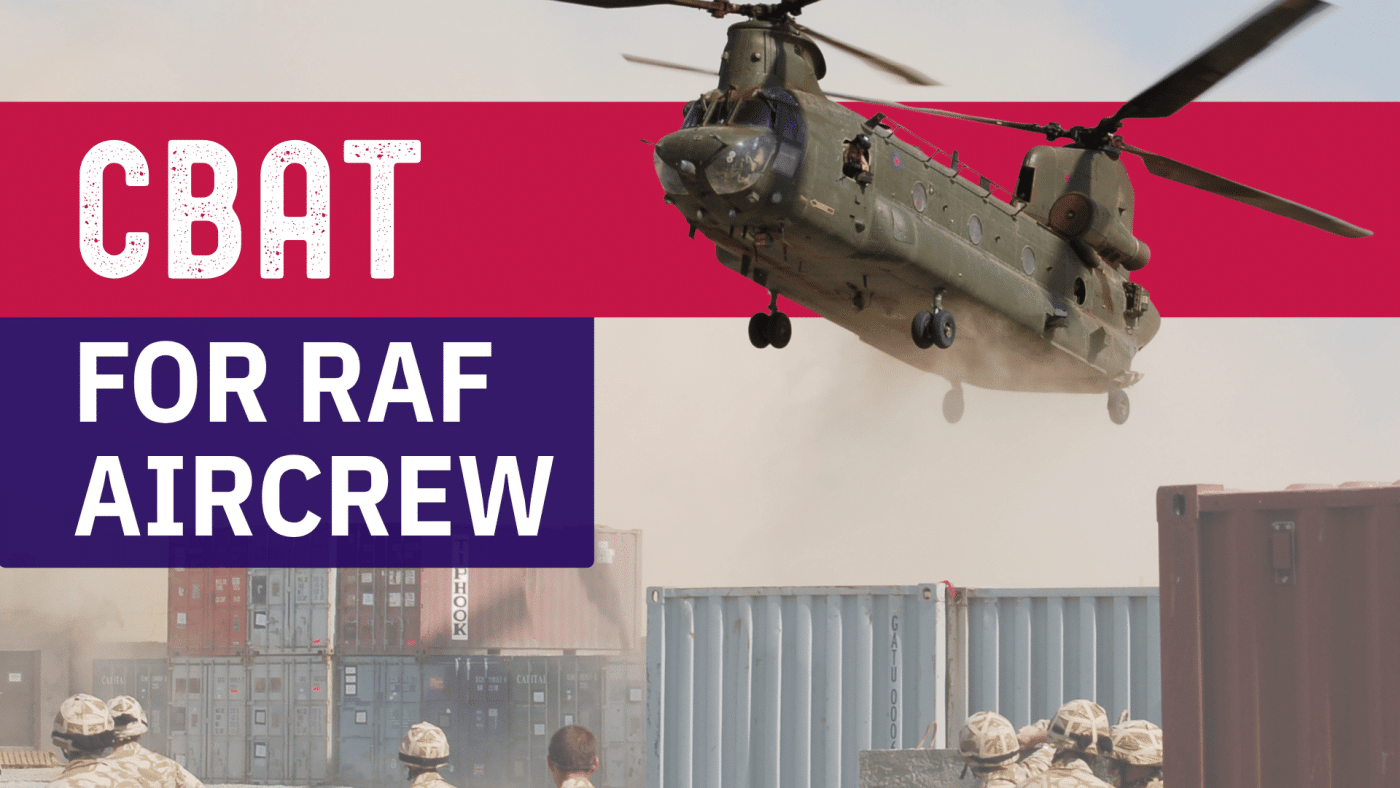
If you are applying for an aircrew role with the Royal Air Force, you may come across the term “CBAT test” which is the Computer-Based Aptitude Test.
This is the stage that quietly filters out a significant number of aircrew applicants. Most candidates do not struggle because they lack ability, but because they do not fully understand what is actually being assessed.
The CBAT assesses how you perform when your brain is under pressure, your attention is stretched, and you are required to stay accurate over time. That is exactly what aircrew roles demand.
Understanding the CBAT Test
What is the CBAT?
The CBAT is designed to stress-test how you think, react, and cope when performance starts to dip.
The RAF is not looking for people who can memorise facts or revise their way to a pass. What really matters is whether you can stay sharp, make sound decisions, and keep performing when tasks become fast-paced or mentally draining.
Where candidates go wrong
A common mistake is treating the CBAT like a traditional exam. Many candidates walk in believing they either “pass” or “fail”, and that mindset often leads to unnecessary pressure and poor performance management.
In reality, the CBAT is used to build a detailed picture of your strengths. Your results help determine:
- Whether you reach the required standard for aircrew roles
- Which roles are the best fit for your natural abilities
If your performance falls below certain thresholds, some roles may become unavailable immediately, even if you perform well later in the process. This is why preparation at this stage is critical.
Where it sits in the process
CBAT takes place early in the selection process, before medicals, fitness tests, and OASC. Because of that, it plays a major role in shaping what options remain open to you.
A strong performance can open multiple pathways. A weaker one can limit them before you have had the opportunity to demonstrate your full potential elsewhere.
What Happens on the Day
The CBAT is a long series of tasks where your brain is continuously pushed to stay accurate while the workload gradually increases.
In practical terms, you may be asked to track a moving object on screen while responding to number prompts, remember sequences while completing another task, or react to audio cues while monitoring visual information. These are not difficult individually, but they become challenging when combined and sustained over time.
It often starts off feeling manageable. However, as the session progresses, speed increases, instructions become more demanding, and fatigue begins to set in. Most candidates notice a drop in concentration after around 60 to 90 minutes. This is intentional.
Strong vs weak candidates
- Weaker candidates chase mistakes and try to “fix” previous errors
- Stronger candidates reset quickly and focus only on the current task
- Weaker candidates rush when pressure builds
- Stronger candidates protect their accuracy and maintain control
The assessors are looking for reliability under pressure.
What the RAF Is Really Measuring
The CBAT is assessing five core capabilities.
1. Attention control
Can you maintain focus when tasks become repetitive or mentally draining? Many errors come from lapses in routine phases, not complex moments.
2. Working memory
Can you hold information while acting on something else? This is tested repeatedly across multiple exercises.
3. Speed with discipline
Many candidates rush as tasks speed up. Strong candidates keep their pace controlled and avoid careless errors.
4. Spatial awareness
This links directly to situational awareness. It is one of the clearest indicators of suitability for pilot and systems roles.
5. Task management
You will be required to divide attention. The RAF is assessing how you prioritise when you cannot do everything perfectly.
If your performance drops sharply under pressure or fatigue, that is the area to focus on. Stable performance across the full session is more valuable than short bursts of high accuracy.
Aircrew Roles: What CBAT Is Preparing You For
The CBAT is built to assess whether you have the core mental skills needed across a range of RAF aircrew roles. These roles may differ in responsibility, but they all demand the ability to process information quickly, stay composed under pressure, and make accurate decisions in real time.
Some of the main aircrew roles CBAT is used to assess for include positions such as Weapon Systems Operator, Intelligence Analyst (Air), Air Traffic Controller, and Pilot.
What these roles are actually like
Aircrew roles are active and mentally demanding. You are constantly interpreting data, monitoring systems, and supporting operational decisions.
In real terms, this may involve:
- Tracking aircraft and updating information in real time
- Monitoring radar or sensor systems for changes
- Managing multiple communication channels
- Supporting fast-paced operational decisions
There is rarely time to stop and think step-by-step. Your ability to respond quickly and accurately is what matters.
Why the CBAT is so important
The tasks you complete are simplified versions of these demands. If you struggle to manage multiple inputs during the CBAT, that tends to carry through into training.
If you can stay composed and consistent despite increasing pressure, it is a strong indicator that you can handle the real environment.
Loadmasters and Weapons: Clearing Up Misconceptions
Do loadmasters carry weapons?
In most cases, no. The core role of a Loadmaster is focused on the safe and efficient movement of cargo and personnel.
However, in certain operational environments, personnel may be required to carry personal weapons. This is always trained, controlled, and governed by strict procedures.
From a selection perspective, what matters is showing that you can operate within structured systems, follow procedures precisely, and remain disciplined in your approach.
How to Prepare Properly
Preparation is where most candidates either gain a clear advantage or waste time.
What does not work
- Random practice with no structure
- Over-focusing on one type of question
- Only practising when you feel fresh
What does work
- Short, consistent daily sessions
- Training weak areas deliberately
- Practising under timed conditions
- Building mental stamina over time
On the day of the test
- Do not dwell on previous tasks, each one is scored independently
- Listen carefully to instructions, many errors come from misreading them
- Use breaks to reset, not to analyse your performance
Simple plan I recommend to candidates
- 20–30 minutes per day of focused practice
- 1 longer session per week to test stamina
- Track mistakes and patterns
The biggest improvement usually comes after candidates stop chasing perfection and start training consistency.
Results and What Happens Next
In many cases, you will receive an indication of your performance on the day, followed by confirmation shortly after.
Your score is used to:
- Determine whether you meet the required standard
- Identify which aircrew roles are realistic options
It is not simply a pass or fail. It is a placement decision, and it directly shapes the rest of your application journey.
Final Advice
If you approach the CBAT casually, it will expose that quickly.
If you approach it with structured preparation, you give yourself a strong advantage.
The candidates who perform best are not always the most naturally gifted. They are the ones who:
- Prepare consistently
- Understand what is being assessed
- Stay composed when it gets difficult
That combination is exactly what the RAF is looking for.
Want to feel fully prepared for the RAF CBAT assessment?
You now understand what the CBAT involves and what the RAF is really assessing. However, knowing the theory is only part of the process. The candidates who perform best are those who have practised under realistic conditions and trained their ability to stay accurate under pressure.
To help you prepare effectively, we have created a comprehensive CBAT practice resource that includes realistic-style questions, timed exercises, and step-by-step guidance to help you improve the exact skills tested during the assessment.
Whether you are just starting your preparation or looking to improve your score from a previous attempt, this resource will help you build consistency, sharpen your performance, and approach the CBAT with confidence.
More walkthroughs and interview tutorials are available on our YouTube channel: https://www.youtube.com/@CareerVidz
