

If you have applied for a role at Amazon, you will likely be asked to complete an Amazon assessment test as part of the hiring process. These assessments are designed to evaluate your decision-making, problem-solving, and working style to see if they align with the role and Amazon’s culture.
In this guide, you will learn:
- What the Amazon assessment test is and why it matters
- How the Amazon Work Style Assessment works
- Practice-style examples of Amazon assessment questions
- How to prepare for the online assessment for different roles
- What to expect after completing the assessment, including interviews
To help you prepare even further, watch our video below covering the 7 most difficult Amazon interview questions, with expert tips on how to answer them effectively.
Introduction to the Amazon Assessment Test
What is the Amazon assessment test?
The Amazon assessment test is an online evaluation used to support hiring decisions. The exact assessment you receive depends on the role, your location, and the stage of the hiring process.
Why Amazon uses assessments
Assessments allow Amazon to measure job-related skills and behaviours consistently across candidates. They are used in positions ranging from warehouse associates to corporate and technical roles.
Which roles usually require an assessment?
Roles that commonly require assessments include:
- Warehouse and fulfilment associate roles
- Customer service roles
- Graduate programmes and internships
- Corporate roles (operations, HR, finance, marketing, project management)
- Technical roles (software engineering, data analytics, IT)
Important: your assessment invitation email is the definitive guide. It tells you what test to take, the time allowed, and which device to use.
Types of Amazon Assessments You Might See
Amazon uses a variety of assessments depending on the role. Common formats include:
- Amazon Work Style Assessment – measures work preferences and behavioural traits
- Work simulation – evaluates responses to realistic workplace scenarios
- Writing exercises – common in professional or corporate roles
- Numerical or verbal reasoning – often used in graduate or corporate recruitment
- Technical assessments – coding or problem-solving tests for technical positions
- Video interviews – may be required for certain roles
If your assessment differs from a friend’s, this is normal. Amazon uses different assessments for different job families.
Understanding the Amazon Work Style Assessment
The Amazon Work Style Assessment (or work style survey) is a behavioural questionnaire. It evaluates how you work in a team, respond to pressure, and approach goals.
Purpose: To see whether your natural working style aligns with the role and Amazon’s culture.
Key traits often evaluated:
- Ownership – taking responsibility and following through
- Customer focus – prioritising service and quality standards
- Bias for action – making timely, sensible decisions
- Integrity – doing the right thing, even when challenging
- Teamwork – collaborating effectively and communicating clearly
- Calmness under pressure – remaining professional in busy situations
Answering the assessment:
- Be honest and consistent; do not exaggerate
- Do not switch between extremes unless accurate
- Pay attention to words such as “often”, “always”, and “only”
- Consider what strong performance looks like for the role
Example: “I check my work even when under time pressure.”
A strong answer shows responsibility and care without implying perfection.
Common Amazon Assessment Test Questions and Practice Examples
Here are practice-style examples to illustrate the type of thinking Amazon assessments reward.
Practice question 1 (Priorities)
You are working on a project with a tight deadline. A colleague approaches you for help on a task that is causing the team to slow down. You also have your own deadline to meet. What do you do?
Options:
A) Focus on your own task first and suggest that your colleague come back later when you are free.
B) Help your colleague immediately, even if it delays your own work.
C) Quickly assess whether the colleague’s task is urgent, offer partial help or guidance, and communicate your own time constraints.
D) Delegate the colleague to someone else and continue your work uninterrupted.
Correct answer: C
Explanation: This approach balances teamwork, ownership, and prioritisation. It shows you consider both your responsibilities and the needs of the team, rather than focusing solely on yourself or neglecting your own deadlines.
Practice question 2 (Integrity)
You notice a colleague is skipping a safety check to save time, which could lead to errors. What do you do?
Options:
A) Follow the same shortcut since the risk seems low and you want to finish quickly.
B) Raise the concern directly with the colleague, complete your own tasks correctly, and inform your supervisor if necessary.
C) Ignore it for now, assuming someone else will notice and address the issue.
D) Ask another team member for advice before deciding whether to act.
Correct answer: B
Explanation: This demonstrates integrity and professionalism. You address the issue responsibly without creating conflict and ensure safety standards are maintained, reflecting Amazon’s expectations for accountability.
Practice question 3 (Customer Focus)
A customer submits a complaint that you believe is partially unfair. How do you respond?
Options:
A) Explain firmly why the customer is wrong and that the complaint is invalid.
B) Listen to the customer’s concerns, clarify facts, and aim for a solution that resolves the issue reasonably.
C) Forward the complaint to a manager and avoid direct interaction with the customer.
D) Acknowledge the complaint but do not make any changes unless the customer insists.
Correct answer: B
Explanation: Amazon values customer obsession. Listening, clarifying, and resolving issues respectfully demonstrates customer focus while maintaining professionalism.
Practice question 4 (Ownership and Learning)
You make a small mistake in a task, but no one has noticed yet. What is the best way to handle it?
Options:
A) Fix the mistake and move on.
B) Inform your manager immediately and ask for guidance.
C) Correct it and review the process to prevent it from recurring.
D) Leave it alone for now and monitor if it causes any problems before acting.
Correct answer: C
Explanation: Taking ownership, addressing the issue proactively, and learning from it reflects Amazon’s leadership principles. It shows accountability and a commitment to continuous improvement.
Practising these scenarios with balanced options helps you think critically and choose answers that align with Amazon’s expectations.
Amazon Assessment Test for Warehouse Roles
Warehouse roles often have faster assessment processes than corporate positions.
Typical steps: application → online assessment → shift selection
Assessment focus areas:
- Safety and following instructions
- Reliability and attendance
- Quality and accuracy
- Teamwork
- Calmness under pressure
Practice question 1 (Safety & Following Instructions)
Your target for picking items is higher than usual today. A teammate suggests skipping a required safety check to save time. What do you do?
Options:
A) Skip the safety check to meet the target and avoid falling behind.
B) Perform the safety check and explain to your teammate why it’s necessary, even if it slows you down slightly.
C) Ask your supervisor whether skipping the check is acceptable before deciding.
D) Ignore the suggestion and continue working, but don’t mention the safety check to your teammate.
Recommended approach: B
Explanation: Following safety procedures is non-negotiable. This option demonstrates responsibility, prioritising safety and quality while also communicating effectively with your teammate. It reflects Amazon’s focus on doing the job correctly and safely every time.
Practice question 2 (Reliability & Attendance)
You are scheduled for a busy shift, but you are unwell and know that coming in could affect your performance and the team’s workflow. How do you respond
Options:
A) Attend the shift and try to manage, while being honest about your reduced capacity.
B) Notify your supervisor promptly, explaining your situation, and discuss options to cover your shift responsibly.
C) Call in sick, trusting the team can cope.
D) Attend the shift but delegate your most critical tasks to a teammate.
Recommended approach: B
Explanation: Taking responsibility includes knowing when you cannot perform safely or effectively. Notifying your supervisor and arranging coverage shows accountability, protects team performance, and ensures quality and safety are maintained. This aligns with Amazon’s principle of ownership applied thoughtfully.
Practice question 3 (Quality & Accuracy)
While checking orders, you notice a few items are incorrectly labelled. You are under time pressure. What do you do?
Options:
A) Correct the labels immediately to maintain accuracy.
B) Note the errors and fix them after completing your batch to maintain pace.
C) Flag the errors to a colleague and continue with your batch.
D) Continue without fixing them, assuming errors are minor and unlikely to be noticed.
Recommended approach: A
Explanation: Accuracy and quality cannot be sacrificed for speed. Correcting errors immediately demonstrates ownership, attention to detail, and a commitment to doing the job right every time, which reflects Amazon’s focus on high standards and customer satisfaction.
Practice question 4 (Teamwork & Calmness Under Pressure)
A new teammate is struggling to keep up during a peak period. Your own tasks are demanding. How do you respond?
Options:
A) Focus solely on your own tasks to ensure targets are met.
B) Offer guidance or assistance where possible, while continuing to manage your own tasks.
C) Step in fully to help your teammate, temporarily reducing your own output.
D) Alert your supervisor and let them handle the situation, while continuing your work.
Recommended approach: B
Explanation: Supporting a teammate while managing your own responsibilities demonstrates teamwork, leadership potential, and composure under pressure. It reflects Amazon’s expectation that employees collaborate effectively while maintaining personal accountability and performance standards.
Preparing for the Amazon Online Assessment
Preparation is straightforward: practise consistently and build skill and confidence rather than cramming.
Step 1: Identify your assessment type
Check your email for instructions about work style, work simulation, reasoning, or technical assessments.
Step 2: Prepare your environment
- Quiet room with no interruptions
- Laptop or desktop if recommended
- Close extra tabs and silence your phone
- Keep water nearby
Step 3: Practise with timed blocks
Timed practice helps you adjust to real assessment pressure.
Step 4: Learn the values behind the questions
Questions often reward ownership, customer focus, integrity, and calm prioritisation.
Step 5: Manage time during the assessment
- Read instructions carefully
- Maintain a steady pace
- Move on from difficult questions and return later if possible
- Recover quickly from mistakes and continue
Software Engineer Intern and Tech Roles
Technical roles, including software development engineer positions, usually have structured online assessments.
Typical components:
- Coding assessments
- Work style assessments
- Work simulations for some full-time roles
- Optional feedback surveys
Preparation tips:
- Master the basics of your chosen coding language
- Follow a structured problem-solving approach: understand, plan, code, test, optimise
- Practise timed problems to stay calm under pressure
- Follow instructions carefully regarding allowed resources
Mindset: Focus on completing solutions correctly first, then optimise. If stuck, move to the next problem and return if time permits.
Post-Assessment: What to Expect Next
After completing an assessment, you may:
- Receive an invitation to an interview or interview loop
- Be informed you are not progressing
- Be asked to complete additional assessments or writing exercises
Preparing for interviews:
Amazon interviews are mostly behavioural and linked to leadership principles. Use the STAR method (Situation, Task, Action, Result) to structure answers. Develop several STAR examples from work, education, or life experience, and practise speaking them aloud for confidence.
Frequently Asked Questions
Is the Amazon assessment test hard?
It can be challenging due to timing and unfamiliar formats. Practice and understanding question intent improves performance.
Where can I find Amazon assessment questions?
Avoid relying on exact live questions. Use realistic practice scenarios to understand behaviours being assessed.
How do I pass the Amazon Work Style Assessment?
Answer honestly, stay consistent, and reflect behaviours that match the role.
What interview questions should I prepare for?
Expect behavioural questions focused on problem-solving, teamwork, handling pressure, and achieving results. STAR answers are essential.
Final Thoughts: Improving Your Score
To perform well:
- Practise under timed conditions
- Focus on situational judgement and calm decision-making
- Answer work style questions consistently
- Prepare STAR stories in advance for interviews
Action step: Complete one timed practice set today and review mistakes thoroughly. Repeating this habit improves results faster than any other method.
Want to ace your Amazon Work Styles Assessment and wider tests first time?
You now know what to expect from the Amazon Work Styles Assessment and how to build your confidence with targeted practice. But Amazon’s recruitment process doesn’t stop there. Alongside the Work Styles personality‑style section, you could face situational judgement, numerical reasoning, mechanical comprehension, data interpretation and work simulation tests as part of the overall online assessment.
To help you go into every part of the assessment fully prepared, we’ve created a powerful practice resource that gives you free access to a complete Amazon assessment training suite. This includes:
- 100s of Amazon‑style practice questions across multiple test areas, including work styles, situational judgement, numerical reasoning, mechanical and electrical comprehension, and more
- Fully worked answers so you can learn how questions are solved and understand common pitfalls
- Interactive score tracking so you know exactly where you need to improve
- 58 mock tests to simulate real test conditions across all key Amazon assessment formats
- Instant digital access via your How2Become dashboard — start practising in minutes
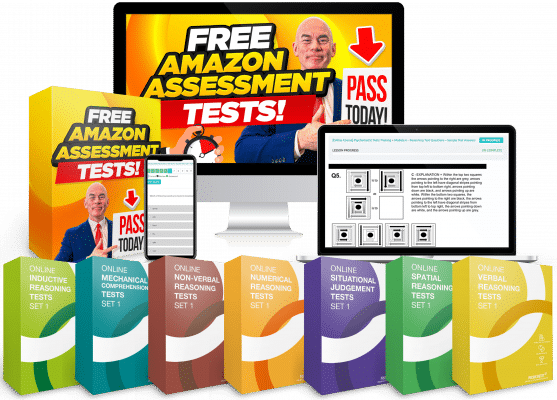
Whether you’re aiming to improve your Amazon Work Styles Assessment responses, boost your performance in other psychometric tests, or go into every stage of the process with confidence, this complete practice suite gives you the preparation edge you need.
Yes! Help me pass my AMAZON ASSESSMENT!More walkthroughs and interview tutorials are available on our YouTube channel: https://www.youtube.com/@CareerVidz
