


If you have applied for a role through Civil Service Jobs, you may be asked to complete the Civil Service Numerical Test as part of the online assessment process.
Do not worry. This test is not about tricky or advanced maths. Its purpose is to measure how well you can interpret data, carry out accurate calculations, and make reasoned decisions based on numbers. In a Civil Service role, this could involve analysing performance figures, checking budgets, reviewing caseloads, or spotting trends in reports.
This guide will help you understand:
- What the Civil Service Numerical Test measures and why it is used
- The types of questions you may face, including numerical reasoning and verbal reasoning formats
- How to prepare effectively using practice tests and sample questions
- Where to find reliable practice resources, including free options
- Strategies to stay calm and perform at your best on the day
For a quick visual guide with practical numerical tips and tricks, check out the YouTube video right below.
Understanding the Civil Service Numerical Test
What is a Civil Service Numerical Reasoning Test?
A numerical reasoning test is a timed assessment designed to measure your ability to interpret data, identify trends, and solve problems using numerical information. It forms part of the Civil Service Fast Stream and other entry-level and professional recruitment processes.
Why it matters:
These tests ensure candidates have the quantitative skills needed to make informed, accurate decisions. Strong numerical reasoning skills demonstrate attention to detail, analytical thinking, and the ability to handle real-world scenarios efficiently.
Typical candidates: Graduates, entry-level professionals, and experienced professionals applying for roles that require decision-making based on numerical data.
Key tip: Your test invitation will confirm the test type, format, duration, and device requirements. Always read this carefully before beginning.
Types of Questions in the Test
Although the main focus of the Civil Service tests is on numerical skills, some campaigns may also assess verbal reasoning or judgement. Depending on the role, you might be asked to complete a single assessment or multiple tests.
Numerical reasoning question formats
- Interpreting information presented in tables, bar charts, line graphs, or dashboards
- Calculating percentage changes or differences
- Working with ratios, averages, totals, and comparisons
- Identifying which conclusions are supported by the data
Verbal reasoning question formats
- Reading a short passage and deciding whether a statement is True, False, or Cannot Say
- Identifying conclusions that are directly supported by the text
- Avoiding assumptions and paying close attention to the exact wording
Key point: Both numerical and verbal tests reward careful reading. Many mistakes happen when candidates rush and miss words such as “some,” “only,” “most,” or “at least.”
Sample Civil Service Test Questions
Civil Service Numerical Reasoning Practice Questions
Table: Monthly Casework Outcomes
| Month | Cases received | Cases closed | Average handling time (days) |
|---|---|---|---|
| September | 1,250 | 1,100 | 9.0 |
| October | 1,400 | 1,260 | 8.1 |
| November | 1,500 | 1,425 | 7.8 |
Question 1: From September to November, by what percentage did the average handling time decrease?
- A) 10.0%
- B) 13.3%
- C) 15.0%
- D) 20.0%
Answer: B
Explanation: 9.0 → 7.8 = drop of 1.2. Percentage drop = 1.2 ÷ 9.0 = 0.1333 = 13.3%
A local government department has a total annual budget of £320,000. The budget is split as follows:
- Staff salaries: 45%
- Operational costs: 30%
- Training: 10%
- Contingency fund: ??
Question: How much money is allocated to the contingency fund?
A) £32,000
B) £48,000
C) £64,000
D) £72,000
Answer: B
Explanation:
Add the known percentages: 45% + 30% + 10% = 85%
Remaining percentage for the contingency fund = 100% − 85% = 15%
320,000 × 0.15 = 48,000
A project team consists of 12 senior staff and 18 junior staff. Each senior staff member works 40 hours per week, and each junior staff member works 25 hours per week.
Question: What is the ratio of total senior hours to total junior hours?
- A) 4:3
- B) 12:9
- C) 16:15
- D) 8:5
Answer: C
Explanation:
- Total senior hours = 12 × 40 = 480 hours
- Total junior hours = 18 × 25 = 450 hours
- Ratio = 480:450 → divide both by 30 → 16:15
Preparing for the Civil Service Practice Test
The key to success is practising in a way that builds accuracy first, then speed. Rushing too early can create bad habits.
Effective study strategies:
- Practise regularly: Short, frequent sessions improve retention and confidence.
- Focus on core topics: Percentages, ratios, averages, totals, and reading tables/charts.
- Review mistakes: Write down why you got questions wrong to avoid repeating errors.
- Master one question type at a time: Repeat until the method becomes automatic.
- Maintain a calm pace: Avoid panicking on the day by practising under controlled conditions.
Step-by-step method:
- Read the question first to know what to look for.
- Scan the table/chart for relevant figures only.
- Perform calculations carefully and sense-check your answer.
- Select the closest option and move on.
Tips for Success on Test Day
Calm, careful execution will have the biggest impact on your score. Most candidates know the maths; mistakes happen when questions are misread or rushed.
Time and pace management:
- Work steadily, even if the test is untimed.
- Move on if a question is taking too long.
- Pause to sense-check answers that look unusual.
Staying calm and focused:
- Choose a quiet, distraction-free space.
- Keep pen and paper handy for workings.
- Take a deep breath before starting to gain control and focus.
Reviewing answers effectively:
- Check units (e.g., pounds vs thousands).
- Watch for qualifiers like “most” vs “all” and “increase” vs “decrease.”
Reasonable adjustments: Candidates requiring accessibility support can request adjustments to ensure their performance reflects their ability.
Want to ace your Civil Service Assessments first time?
You now know what to expect from the Civil Service Numerical Tests, and how to build your confidence with targeted practice. But Civil Service recruitment doesn’t stop there. Alongside this key assessment, you could face verbal reasoning, logical reasoning, work simulation exercises, and other psychometric tests as part of the overall online assessment process.
To help you go into every part of the assessment fully prepared, we’ve created a powerful practice resource that gives you free access to a complete Civil Service assessment training suite. This includes:
- 100s of Civil Service–style practice questions across multiple test areas, including numerical reasoning, situational judgement, verbal reasoning, logical reasoning, and more
- Fully worked answers so you can learn how questions are solved and understand common pitfalls
- Interactive score tracking so you know exactly where you need to improve
- 58 mock tests to simulate real test conditions across all key Civil Service assessment formats
- Instant digital access via your How2Become dashboard — start practising in minutes
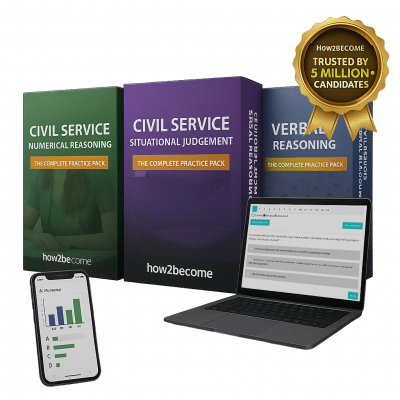
Whether you’re aiming to improve your numerical test scores, master situational judgement scenarios, or go into every stage of the Civil Service recruitment process with confidence, this complete practice suite gives you the preparation edge you need.
Yes! Help me pass my CIVIL SERVICE ASSESSMENT!More walkthroughs and interview tutorials are available on our YouTube channel: https://www.youtube.com/@CareerVidz
