

If you’re preparing to join the police, understanding the UK police selection process 2025 is essential. Becoming a police officer in the UK is one of the most rewarding but also one of the most competitive career journeys you can embark on. Every year, thousands of applicants begin the recruitment process, but only a fraction make it through to training school. Understanding the selection stages, what recruiters are looking for, and how to prepare effectively can make all the difference.
In May 2025, an important change came into effect: every police force across the country moved over to the updated Competency and Values Framework (CVF 2024). This framework defines the standards, behaviours, and values expected of all police officers. While the CVF has existed for years, the 2024 refresh clarified language, aligned it more closely with the Code of Ethics, and put greater emphasis on inclusivity, fairness, and public service. For applicants, this means that every stage of assessment, from online tests through to interviews and written tasks, is judged explicitly against these behaviours.
This guide will walk you through the entire police recruitment process, explain what each stage involves, share insider tips on how to stand out, and provide example questions and answers. Whether you’re just starting your journey or preparing for your final interview, this is everything you need to know.
The UK Police Selection Process 2025 at a Glance
Although exact details vary slightly between forces, most follow a similar structure:
-
Online registration and application
-
Eligibility checks and submission of evidence
- National SIFT assessments (situational judgement test and behavioural styles questionnaire)
-
Online assessment centre (including video interview, written exercises, and briefing exercises)
-
Force-level interview
-
Fitness test and medical
-
Vetting and background checks
-
Job offer and training
Let’s explore each stage in depth.
Stage 1: Application and Eligibility Checks
The process begins with your online application. This is where you provide your personal details, employment history, and any supporting evidence such as qualifications. Forces also carry out eligibility checks, including nationality, right to work, criminal convictions, and sometimes residency requirements.
Tips for success:
-
Double-check your eligibility before applying. Small oversights (such as misunderstanding qualification requirements) can cost you weeks of wasted effort.
-
Take time to prepare your supporting documents in advance. Uploads should be clear, legible scans not photographs that are difficult to read.
-
Many forces include short application questions such as “Why do you want to be a police officer?” Use these to show genuine motivation and align yourself with the CVF.
Example application response:
“I am applying to become a police officer because I care deeply about public service and protecting the community. Through volunteering with a local youth centre, I worked with partners to reduce anti-social behaviour by coordinating outreach sessions. This experience showed me the importance of collaboration, taking ownership, and building trust. I believe these skills align with the values of the police service, and I am eager to bring them to a full-time policing role.”
Stage 2: The National Sift
Before you reach the Online Assessment Centre, you must now pass the National Sift. This is a national entry stage designed to reduce the number of candidates progressing further, and it contains two exercises:
Situational Judgement Test (SJT)
- You will be presented with a series of realistic policing scenarios. For each scenario, several possible actions are provided.
- Unlike older-style SJTs where you only picked the “best” and “worst” options, here you must rate every response option on a scale (e.g. “very effective” through to “counterproductive”).
- This means you must consider each answer carefully, don’t just spot the obvious “good” one. Often more than one option is partially effective, so balance fairness, safety, and CVF values in your judgements.
- Preparation tip: Always prioritise public safety, professionalism, and collaboration. Responses that escalate unnecessarily, ignore vulnerable people, or show poor judgement should be rated less effective.
Behavioural Styles Questionnaire (BSQ)
- This is a personality-style assessment where you are asked how much certain statements describe you. For example: “I enjoy working closely with others to solve problems.”
- There are no right or wrong answers, but consistency is key. The BSQ checks whether your preferred behaviours align with the values and demands of policing.
- Preparation tip: Be honest. Trying to “second-guess” what the test wants can lead to inconsistent responses, which may reduce your score.
The National Sift is a pass/fail filter. If you do not achieve the required standard, you won’t progress to the Online Assessment Centre. This makes preparation essential, especially for the SJT, where practice helps you spot patterns in what policing values look like in action.
Sample SJT scenario:
While on foot patrol, you see two teenagers arguing loudly. One appears aggressive, and members of the public are starting to watch.
Rank each option as: Counterproductive / ineffective / slightly ineffective / effective / very effective
-
Option A: Tell them to calm down loudly and threaten arrest if they don’t stop.
-
Option B: Move in calmly, separate the teenagers, and ask what has caused the argument.
-
Option C: Ignore the situation; they’ll probably stop on their own.
-
Option D: Call immediately for backup. Don’t attempt to intervene when you are by yourself.
Example answers:
-
Option A: Ineffective – may escalate the conflict.
-
Option B: Very effective – prioritises safety, de-escalation, and emotional awareness.
-
Option C: Very ineffective – ignores public safety.
-
Option D: Somewhat effective – calling backup is sensible in some cases, but not before attempting safe de-escalation.
This rating approach is what you’ll be expected to do on the real test.
Stage 3: The Online Assessment Centre
The College of Policing’s Online Assessment Centre (OAC) is a standard part of recruitment used by all UK forces. It is designed to assess candidates against the CVF in a fair and consistent way.
You can expect up to three key exercises:
-
Video interview: You record answers to pre-set competency questions, which are linked to the CVF.
-
Written exercise: You analyse information and produce a structured written response, such as a report or recommendation.
-
Briefing exercise: You are given information about a scenario and asked to prepare a briefing for a senior officer.
How to prepare:
-
For the video interview, practise recording yourself answering questions in STAR format (Situation, Task, Action, Result). Aim to sound natural rather than scripted.
-
For the written exercise, practise summarising large amounts of information into concise, well-structured recommendations.
-
For the briefing exercise, always present options, weigh up pros and cons, and make a clear recommendation with justification.
The Competency-Based Interview
In the video interview, you will be presented with several pre-set competency-based questions that map directly to the CVF. You will be given a short preparation window for each question before recording your answer on camera. These questions are designed to assess behaviours such as taking ownership, collaboration, emotional awareness, and public service.
Tips to prepare and succeed:
-
Use the STAR technique (Situation, Task, Action, Result) to structure your answers clearly.
-
Focus on recent, real-life examples that clearly demonstrate:
-
Courage: acting decisively or ethically in challenging situations
-
Respect & Empathy: treating people fairly, listening, and considering perspectives
-
Public Service: prioritising community outcomes
-
Taking Ownership: taking responsibility and driving action to a successful conclusion
-
Innovative & Open-Minded: considering alternative approaches or new solutions
-
-
Practice speaking confidently to a camera. Pause briefly before starting, maintain eye contact with the camera lens, and avoid sounding memorised.
-
Include measurable outcomes where possible; assessors look for tangible evidence of your impact.
Example Video Interview Question:
“Tell us about a time you had to work with multiple agencies or partners to solve a problem.”
Model Answer (STAR):
-
Situation: While volunteering at a youth centre, anti-social behaviour in the local park was rising.
-
Task: I was asked to coordinate a community-based intervention.
-
Action: I organised meetings with PCSOs, council staff, and youth workers, delegated tasks, and implemented workshops and outreach sessions.
-
Result: Attendance at events rose by 40%, and complaints about anti-social behaviour fell by 20%.
The Written Exercise
The written exercise assesses your ability to analyse information, make decisions, and communicate effectively in writing. For this exercise, assessors are focusing on the CVF behaviours:
-
Respect & Empathy – considering the impact on people and treating them fairly
-
Analysing Critically – reviewing information carefully, identifying key issues, and making sound judgements
-
Support & Inspire – helping others understand your recommendations and encouraging positive outcomes
- Working Collaboratively – demonstrating teamwork and coordination in problem-solving
You may be asked to summarise reports, provide recommendations, or draft an officer-style document.
Tips to prepare and succeed:
-
Use a structured format: Recommendation → Key facts → Options → Preferred action → Implementation.
-
Clearly identify key issues and prioritise them based on impact.
-
Consider the human and community element in your decisions to demonstrate Respect & Empathy.
-
Include collaborative solutions where relevant, showing how your recommendations would involve or support colleagues or partners.
-
Keep your writing concise, clear, and actionable. Assessors value logical reasoning and practical outcomes.
Example Written Exercise Question:
“A local park has experienced repeated anti-social behaviour, including littering, noise complaints, and minor vandalism. Draft a short report summarising the problem, possible actions, and your recommended approach.”
Sample Response:
Recommendation: Implement a short-term collaborative patrol and engagement initiative with community groups.
Key Facts: Multiple complaints of anti-social behaviour, local residents feeling unsafe, minor vandalism reported.
Options:
-
Increase police patrols.
-
Organise community engagement activities with local volunteers and youth groups.
-
Conduct an environmental review (lighting, CCTV) with council support.
Preferred Option: Combine patrols with community engagement and council support for environmental review.
Implementation: Coordinate patrols with local PCSOs, schedule engagement activities to involve community members, review environmental improvements, and provide updates to local stakeholders.
Briefing Exercise
The briefing exercise evaluates your ability to analyse information, prioritise, and communicate clearly to a senior officer or partner agency. It tests practical decision-making while demonstrating CVF behaviours, with a focus on:
-
Public Service – prioritising the needs of the community and ensuring decisions serve the public interest
-
Emotionally Aware – recognising the impact of actions on others and responding appropriately
-
Innovative & Open-Minded – considering alternative solutions and creative approaches
-
Taking Ownership – leading on a problem and providing clear, actionable recommendations
You are given a scenario, such as reports of anti-social behaviour or a community issue. Information is presented in stages, simulating how situations unfold in real policing. As each new piece of information arrives, you must revisit your earlier recommendations, adjust priorities, and update your briefing if necessary. This tests your ability to analyse critically, stay emotionally aware, and respond flexibly while maintaining a public service focus.
Tips to prepare and succeed:
-
Start by identifying key facts and prioritising the most critical issues.
-
Present initial recommendations clearly, but be ready to adapt your approach as new details emerge.
-
Demonstrate empathy and community awareness when revising decisions.
-
Show ownership by justifying changes logically and confidently.
-
Keep all updates concise, structured, and solution-focused.
Example Briefing Exercise Question:
Initial Scenario: Multiple complaints of anti-social behaviour at a local park, including noise and minor vandalism.
-
Initial Recommendation: Combine increased patrols with a short-term community engagement programme.
New Information (Stage 2): CCTV footage reveals one individual is responsible for most incidents, and residents request targeted action.
-
Updated Recommendation: Maintain patrols and engagement sessions but focus enforcement efforts on the identified individual while continuing to involve the community.
Further Information (Stage 3): Council confirms lighting improvements can be implemented within two weeks.
-
Final Recommendation: Maintain patrols, community engagement, targeted action for the individual, and implement environmental improvements promptly.
Stage 4: In-force assessment / final interview
After the OAC, some forces run a local in-force process which may include a final panel interview, additional practical tasks or a strengths-based interview. This stage tests fit to local priorities and your ability to reflect on your development.
Top tips
-
Be reflective – show what you learned from past experiences and how you’d apply that learning to policing.
-
Keep it local – show knowledge of the force’s priorities (e.g. safeguarding, anti-social behaviour, neighbourhood policing).
-
Be ready to discuss vetting & ethics – panels may probe past behaviours to see if they align with CVF values.
Stage 5: Fitness & medical
Every force expects you to meet job-related fitness and health standards. Most commonly this includes a bleep/multi-stage shuttle test, plus medical checks (eyesight, hearing, general health).
Preparation checklist
-
Train progressively and mimic the shuttle format. Practise turns and pacing.
-
Build aerobic fitness, strength and mobility; many candidates fail due to poor footwork or turning technique, not pure stamina.
-
Take care of sleep and nutrition in the days leading up to the test.
-
If you need reasonable adjustments (disability, injury), inform the force early and provide supporting medical evidence.
Stage 6: Vetting & background checks
Vetting is comprehensive: criminal records, financial checks, references and social media are all considered. The updated CVF and Code of Ethics mean vetting looks closely at behaviour over time.
Practical vetting advice
-
Disclose what the application asks for – omission is worse than disclosure.
-
Prepare a short summary explaining any past incidents, focusing on learning and change.
-
Clean up social media – remove or archive posts that could be misinterpreted.
-
Brief your referees – make sure they know to expect contact and understand what they may be asked.
Six-week practical preparation plan
Week 1: CVF & STAR stories: Read the CVF document; draft 8–10 STAR examples mapped to competencies.
Week 2: National SIFT practice: Complete multiple SJT practice sets and work through BSQ practice to be consistent.
Week 3: OAC writing & briefing: Timed written tasks and briefing exercises; practise concise recommendations.
Week 4: Mock assessment day: Simulate SIFT and OAC (video answers + written tasks) with time limits and feedback.
Week 5: Fitness focus: Structured fitness plan for shuttle/bleep plus mobility and strength.
Week 6: Final polish: Review STAR answers, check documents, brief referees, prepare vetting statement, rest.
Common mistakes applicants make in the UK police selection process 2025 (and how to avoid them)
Vague examples: Use specifics and measurable outcomes. Avoid “we did” – use “I did.”
Not using CVF language: Make it easy for assessors to map your evidence to competencies.
Over-rehearsed answers: Be natural – panels can spot scripted responses.
Leaving fitness to the last minute: Fitness improvements take time; start early.
Trying to ‘game’ the BSQ: Inconsistent answers look suspicious; be honest and consistent.
The How2Become Police Tests Guide gives you hundreds of practice questions, fully worked answers, and insider tips for every stage of the UK police selection process 2025 – including situational judgement, written exercises, briefing exercises, and the new online assessment process.
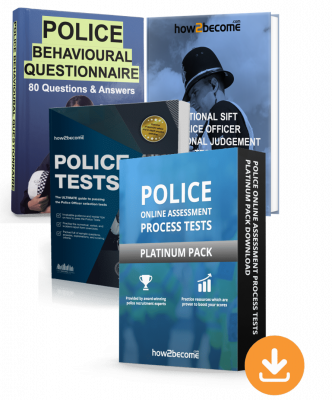
Whether you’re starting out from scratch or a seasoned pro at the online assessment exercises, these guides will boost your confidence, improve your scores, and help you stand out from the competition.
✅ Fully up-to-date for 2025
✅ Written by a former police recruiter
✅ Includes practical tips to succeed in every test
Don’t leave your police career to chance – download your guide today and start preparing like a pro!
DOWNLOAD NOW