

THE POLICE CVF
The Competency and Values Framework, usually referred to as the police CVF, sits at the centre of modern UK police recruitment. If you are applying to become a police officer, you will come across it at every major stage of the process.
Candidates often underestimate how consistently the CVF is applied. It is used to assess you through your application, your SIFT stage, your online assessments, and your final interview.
Understanding how it is used at each stage gives you a real advantage in preparation.
What the CVF Covers
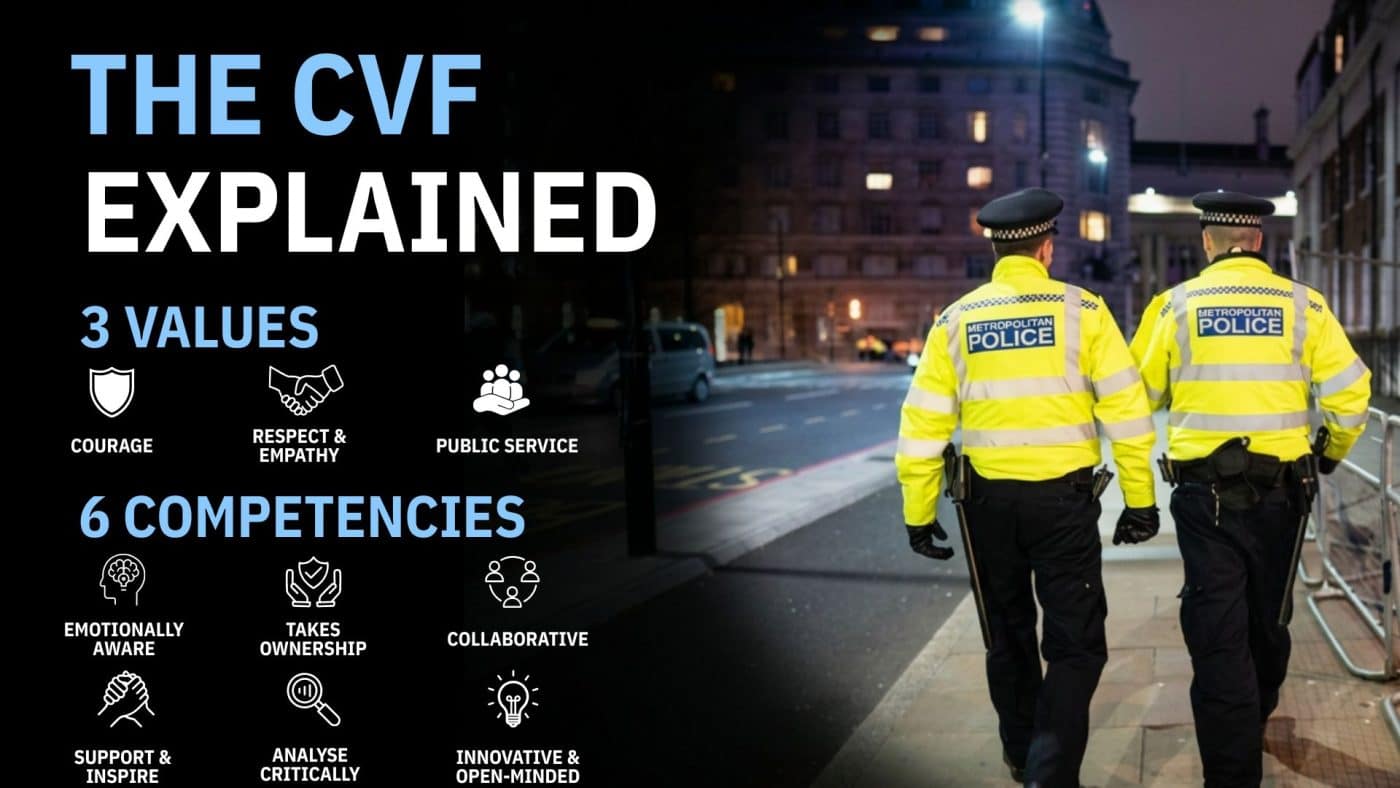
The police CVF sets out the values and behaviours expected of everyone working in policing. It is made up of two parts: values and competencies.
Core values
- Courage
- Respect and empathy
- Public service
Core competencies
- We are emotionally aware
- We take ownership
- We collaborate
- We support and inspire
- We analyse critically
- We are innovative and open-minded
Together, these define how police officers are expected to think and behave in real situations.
Why the CVF matters in recruitment
Every stage of the recruitment process uses the police CVF as a reference point for assessment. This allows police forces to judge candidates in a consistent way, regardless of the format of the task.
You will see CVF expectations reflected in written answers, scenario-based tests, behavioural questionnaires, and interview questions.
For candidates, this means preparation needs to go beyond learning the format of each stage. You also need to understand the behaviours being assessed.
What the CVF means in practice
Understanding the CVF means knowing what each one looks like in real behaviour and how you can demonstrate it in your examples, assessments, and interviews.
Values
Courage
Courage involves doing the right thing, even when it is difficult or uncomfortable. It also includes being willing to challenge poor behaviour and take responsibility when situations are uncertain.
How to demonstrate it:
- Speaking up when something is not right
- Making difficult decisions under pressure
- Taking responsibility for your actions
- Dealing with challenging or confrontational situations in a calm way
Respect and empathy
This value is about treating people fairly, listening to others, and understanding different perspectives, especially in difficult or emotional situations.
How to demonstrate it:
- Listening carefully before responding
- Showing understanding in sensitive situations
- Treating people fairly, even when under pressure
- Adjusting your approach depending on the situation or individual
Public service
Public service reflects a commitment to helping and protecting the public. It focuses on prioritising community needs and acting in the public interest.
How to demonstrate it:
- Putting others’ needs before your own convenience
- Supporting vulnerable people or those in need
- Taking action that benefits the wider community
- Staying focused on fair and ethical outcomes
Competencies
We are emotionally aware
This is about recognising your own emotions and understanding how others may be feeling in different situations.
How to demonstrate it:
- Staying calm in stressful situations
- Recognising when someone is upset or anxious
- Adjusting your behaviour to suit the situation
- Reflecting on how your actions affect others
We take ownership
This competency focuses on responsibility and accountability for your actions, decisions, and outcomes.
How to demonstrate it:
- Taking responsibility when something goes wrong
- Following tasks through without being chased
- Making decisions confidently when required
- Learning from mistakes and improving performance
We collaborate
Collaboration is about working effectively with others to achieve a shared goal, even when there are differences in opinion or approach.
How to demonstrate it:
- Working well in a team environment
- Sharing information openly with others
- Supporting colleagues when needed
- Resolving disagreements professionally
We support and inspire
This involves helping others perform at their best and encouraging positive behaviour within a team or group.
How to demonstrate it:
- Helping others when they are struggling
- Giving clear and constructive feedback
- Encouraging teamwork and motivation
- Leading by example in your behaviour
We analyse critically
Critical analysis is about assessing information carefully before making decisions, especially when situations are complex or unclear.
How to demonstrate it:
- Considering all available information before acting
- Identifying risks and consequences
- Making balanced and logical decisions
- Avoiding assumptions and checking facts
We are innovative and open-minded
This competency focuses on being flexible, adaptable, and willing to consider new approaches or ideas.
How to demonstrate it:
- Adapting quickly to new situations
- Being open to feedback and different viewpoints
- Trying alternative approaches when needed
- Learning from experience and improving methods
SIFT stage (BSQ and SJT)
The SIFT typically includes:
- Behavioural Styles Questionnaire (BSQ)
- Situational Judgement Test (SJT)
At this stage, you are being assessed on how you approach workplace scenarios and how consistent your judgement is with policing expectations.
What matters most here:
- How you prioritise actions in different situations
- How consistent your responses are across questions
- How closely your decisions align with expected policing behaviours
There is not always a straightforward answer. What matters is the reasoning behind your choices and how they reflect the CVF.
Online Assessment Centre (OAC)
The OAC consists of three exercises:
- A competency-based interview (conducted virtually)
- A written exercise
- A briefing exercise
Although each exercise is different in format, all three are designed to assess your judgement, communication skills, decision-making ability, and alignment with the CVF.
Virtual Interview
During the interview, you will be asked 5 questions about your experiences and how you have handled specific situations in the past. Each one will be directly linked to one of the competencies or values.
Written Exercise
In the written exercise, you are placed in the role of a police officer and presented with an email or urgent task from a line manager. Alongside the task, you will receive several supporting documents, which may include emails, reports, community feedback, complaints, news articles, or other pieces of information.
Your role is to review the information and draft a written response addressing a series of questions.
For example, you may be asked to identify:
- The main issues raised
- The potential impact on the community
- Key risks or concerns
- Recommended actions
- The reasons behind your recommendations
Briefing Exercise
The briefing exercise assesses your ability to absorb information, identify priorities, and make sound decisions as new information becomes available.
Rather than receiving all of the information at once, you are presented with information in a series of separate stages. As the exercise progresses, additional information is provided and you are required to answer questions based on what you have read.
Candidates are often required to:
- Identify the most important issues
- Explain the risks involved
- Justify their decisions
- Prioritise actions
- Adapt their recommendations when new information is introduced
This closely reflects the reality of policing, where officers rarely have all the information available at the outset of an incident.
Want Expert Guidance on Passing the Police Recruitment Process?
Understanding the police CVF is important, but knowing how to apply it during throughout your entire application is what ultimately determines your success.
If you’d like step-by-step guidance, our Police Recruitment Training Webinar is designed to show you exactly what assessors are looking for and how to maximise your score at every stage of the process.
During this intensive live-streamed training webinar, you’ll learn:
✓ How the police recruitment process works from start to finish
✓ How the CVF is assessed throughout the selection process
✓ Proven techniques for passing the SIFT stage
✓ What assessors are looking for in the OAC interview, written exercise and briefing exercise
✓ How to answer competency-based interview questions with confidence
✓ Insider preparation strategies that have helped thousands of candidates succeed
The webinar is delivered by Richard McMunn, one of the UK’s most experienced recruitment and assessment specialists.
Whether you are just starting your application or preparing for an upcoming assessment, this webinar will give you a clear action plan for success.
Join the Next Police Recruitment Training Webinar
Book your place here
I found this useful, bookmarking for later