


If you are applying to become a trainee train driver, one of the most important stages of the recruitment process is the psychometric assessment. These assessments are designed to measure whether you have the concentration, accuracy, memory, reaction speed, coordination, vigilance and decision-making skills needed to work safely in the train driver role.
The current train driver psychometric assessment process is linked to RIS-3751-TOM Issue 4, the Rail Industry Standard used for psychometric assessment in train driver selection. RSSB confirms that Issue 4 applies to candidates who will drive on the GB mainline railway and was introduced to update and clarify the assessment process.
On the 7th December 2024, there was a major change to the process, which allowed for candidates to be able to have three attempts to pass the psychometric assessments, but there are certain condition to qualify for the third attempt. During this blog, we will discuss these and ways for which you can prepare for this all important assessment.
What is the Three Attempt Rule for the Psychometric Assessment
On the 7 December 2024, the train driver psychometric assessment rules changed under RIS-3751-TOM Issue 4. New candidates entering the standardised psychometric assessment process from this date now have up to three attempts to pass the required assessment process.
Previously, candidates were usually limited to two attempts. This meant that failing twice could prevent a candidate from progressing with train driver applications in the future. The updated rule gives candidates an additional opportunity, while still keeping the assessment process strict and safety-focused.
However, the three-attempt rule does not mean candidates can simply retake the tests immediately.
The current rules state that:
- A second attempt can only take place at least one year after the first failed attempt.
- A third attempt can only take place five years after the first failed attempt, and at least one year after the second failed attempt.
Candidates who had already started the assessment process before 7 December 2024 would still be treated under the previous rules, depending on their circumstances.
This makes preparation extremely important. Even though candidates may now have three opportunities, the waiting times between attempts mean that failing can still delay your train driver career by a significant amount of time.
Why the Trainee Train Driver Assessments Matter
Train drivers work in a safety-critical environment. They need to stay focused for long periods, process information accurately, respond quickly to changing situations, follow rules and procedures, and remain calm under pressure.
The assessment process is designed to test these abilities before a candidate begins driver training. Candidates may sit a range of assessments, including tests linked to concentration, vigilance, memory, visual perception, coordination, rules and procedures, and behavioural judgement.
The structue and the number of assessments can vary based on the operating company you have applied for. Some companies will assess you against the national standard, wheras others are now increasingly assessing candidates to an enhanced standard. This could include further tests or assessing candidates to a higher criteria than the national standard.
It is also common for some Train Operationg Companies to use a number of online tests as a form of SIFT, prior to the psychometric assessment. The main reason is it helps to eliminate candidates from the process, who will not meet the required standards at the psychometric assessment.
The Standard Trainee Train Driver Assessments
Dots Concentration Test
The Dots Concentration Test is one of the best-known train driver assessment exercises. It is commonly used to assess concentration, accuracy and speed by Candidates are usually required to identify specific dot patterns while working quickly and consistently.
This test can feel simple at first, but many candidates underestimate how hard it is to maintain accuracy under time pressure. There are a number of things you will need to remember when taking this assessment
- Pay attention to the instructions given
- Incorrect chices or missed groups of dits are negatively marked
- Aim for speed and accuracy
- Ensure you practice this assessment prior to your psychometric test
To prepare, candidates can use our Train Driver Dots Concentration practice materials, which are designed to help improve speed, accuracy and concentration. You can access this test here
Coordination Test
The assessment which requires both hands is used to assess hand-eye coordination and the ability to control movement accurately. This is relevant because train drivers need to operate controls carefully, smoothly and safely.
Candidates often find this test difficult because it requires both hands to work together while tracking movement on screen. Practising similar coordination tasks can help you understand the type of control and accuracy required.
There are a number of things you will need to remember when taking this assessment
- Pay attention to the instructions given.
- Do not panic if the you move outside the grid, calmy move the object back inside the track.
- Aim for a consistent and continuous movement.
- Ensure you practice this assessment prior to your psychometric test.
To prepare, candidates can use our Train Driver Coordination practice materials, which are designed to help improve coordination and concentration. You can access this test here
Awareness and Recognition Test
The AART is linked to visual perception and the ability to take in key information quickly. Candidates may be shown images briefly and then asked to identify what they saw.
This type of assessment tests how well you can observe, process and recall visual information under pressure. It is not just about eyesight, it is about speed of perception and attention to detail.
There are a number of things you will need to remember when taking this assessment
- Pay attention to the instructions given.
- Do not assume something is there based on the type of image presented, incorrect answers are negatively marked.
- Aim for a concentration and attention-to-detail.
- Ensure you practice this assessment prior to your psychometric test. Use images you see in a magazine or online to help prepare.
To prepare, candidates can use our AART practice software, which is designed to help improve focus, concentration and attention-to-detail. You can access this test here
Observational Ability Test
The Observational Ability Test is often associated with attention, concentration and the ability to switch focus between different types of information. Candidates may need to search for specific symbols, tones or information while working accurately.
This assessment can be challenging because it tests sustained attention and mental flexibility. Candidates need to avoid rushing, but they also need to work at a strong pace.
This assessment is usually split into three stages:
- Counting of a certain type of Audio tone (low or high pitched).
- Checking multiple sheets of data for a specifc data type.
- Searching for a specific type of data plus listening for a specifc tone, and remembering the number of tones heard.
To prepare, candidates can use our OAT practice software, which is designed to help improve focus, concentration, memory retentiony and attention-to-detail. You can access this test here
The Vigilance Test
The Vigilance Test assesses sustained attention and reaction time. Candidates may need to monitor a screen and respond when a target shape/colour appears.
This can be one of the most demanding tests because it requires concentration, quick reactions and decision making over a long period. Many candidates start well but lose focus as the test continues. What can make it even more difficult is that the colours might be very similar to the target colour.
To prepare, candidates can use our Vigilance practice software, which is designed to help improve focus, concentration, over prolonged periods. You can access this test here
The Assessing Information Test
The Assessing Information Test assesses how well you can understand written information, then extract and retain the relevant information. Candidates are first presented with an audio recording first, followed by the same passage in written format, during the second part of the test, the candidate is allowed to make notes, which are removed by the assessors prior to the last part of the test where the candidate has to answer questions based on the passage.
This can be one of the most demanding tests because it requires not only the ability to extract important information, but also be able to demonstrate a good level of memory retention. What makes it even more difficult is that you could experience a long gap between the last two stages of the test, which further tests your memory ability.
To prepare, candidates can use our Assessing Information software, which is designed to help improve memory retention, understanding information and focus over prolonged periods. You can access this test here
The Checking Tests
The Checking Tests assesses how well you can apply rules and procedures under timed pressure. During the assessment you will be presented with a procedure and rule for checking items to a certain sequence. To make the assessment challenging, you are only shown the correct order for checking at the start of a set of questions.
After a certain number of questions, the order of checking will change which you will then have to adjust the checking sequence to the next set of questions.
To pass this test, you will need to be able to follow pre-definded rules, demonstrate memory retention and be able to switch to a different set of rules as and when instructed to.
To prepare, candidates can use our Checking Tests software, which is designed to help improve memory retention, understanding information and how to switch focus at short notice. You can access this test here
SIFT AND ENHANCED ASSESSMENTS
Some candidates may also face SIFT tests or enhanced assessment exercises as part of the recruitment process. These can vary by train operating company, but they may include additional judgement, information processing, checking, concentration or suitability-based exercises.
Because the process can vary, candidates should prepare across a broad range of assessment areas rather than focusing on only one test. Some companies hav started using Gmaified Assessments to assess candidates to an enahnced level and as a SIFT.
At Hiw2become, we do have a Gamified Assessment package which you can access at the link below
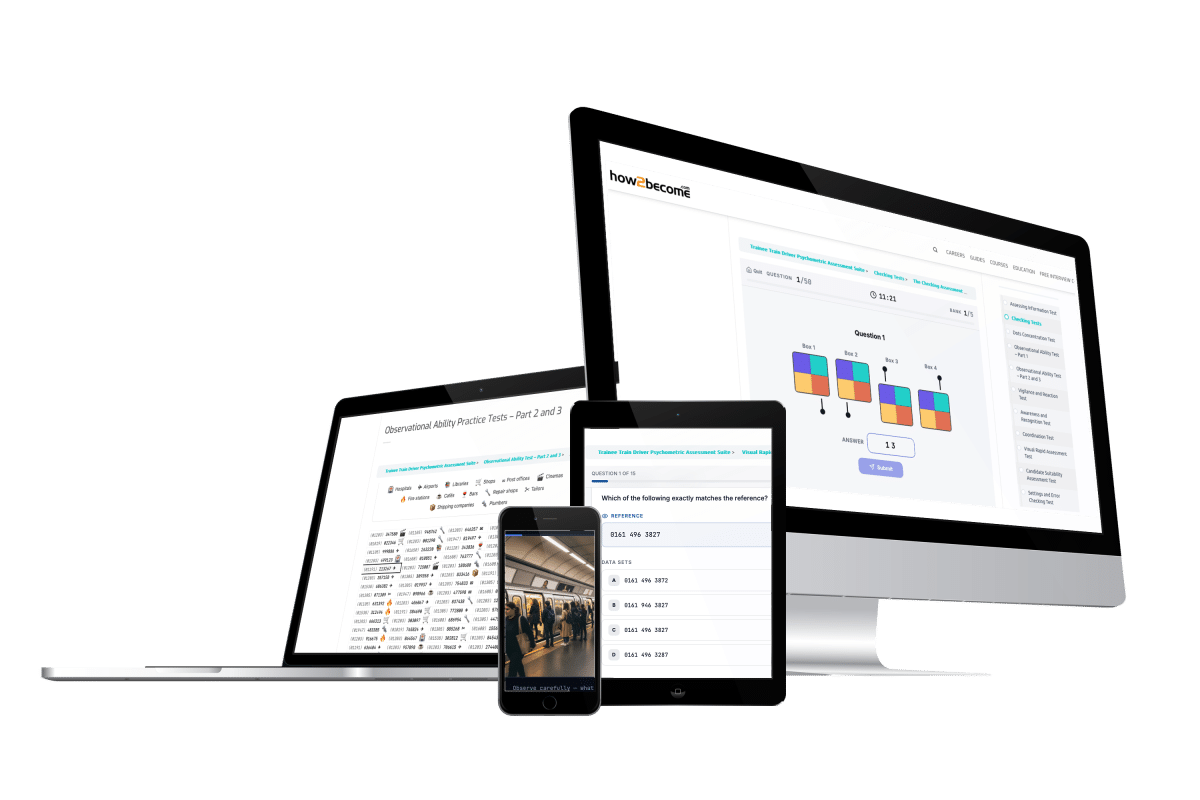
INTRODUCING OUR NEW TRAINEE TRAIN DRIVER ASSESSMENT SUITE VERSION 2.0
To help candidates prepare more thoroughly, we have created a new online train driver assessment suite. This includes brand-new versions of our existing practice tests, covering:
- Dots concentration tests software
- Coordination-style practice software
- AART-style visual perception tests
- OAT attention tests
- Vigilance tests
- Assessing information tests
- Checking tests
- SIFT-style tests
- Enhanced assessment preparation
Please note our tools are not the same as the actual assessments, but they are similar to the actual tests do assess the same skills which are required to pass your Trainee Train Driver Psychometric Assessment.
Now available for the first time as a one off purchase or monthly subscription, this exclusive offers the following:
- Accessed online, no downloading required.
- Compatible with any device or operating system
- The complete assessment package, prepare for all of your assessments in one place.
- Saved in session scoring, so you know where you need to improve.
- Unlimited practice with randomly generated exercises.
- Designed and tested by our own assessment centre experts.
